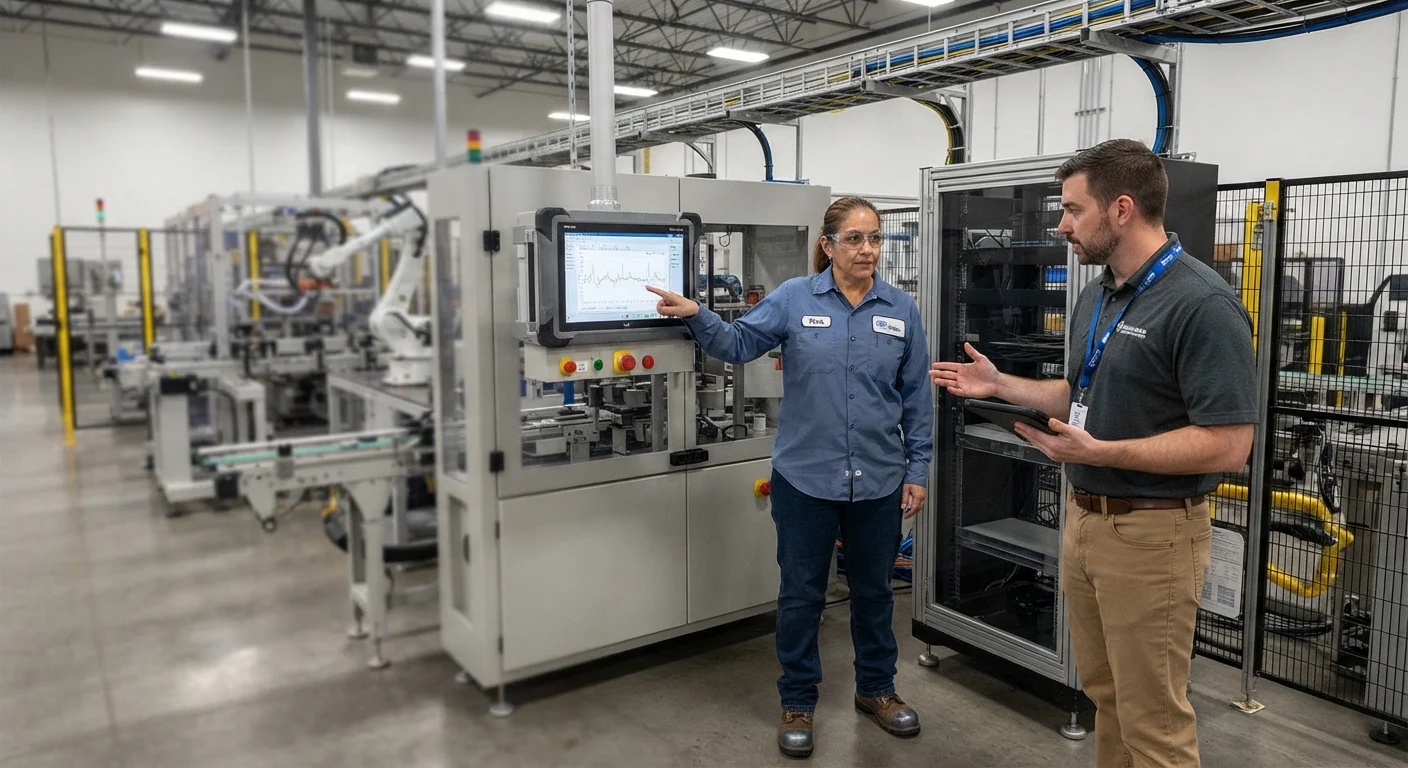
Most New Jersey plants still treat downtime as a maintenance problem, and that is why it keeps happening. The line stops because a historian server ran out of disk, a firmware push bricked an HMI, or ransomware reached the engineering workstation through a vendor’s remote access tool. A wrench doesn’t fix any of those. The pattern is common across mid-sized manufacturers: the maintenance schedule is tight, and the IT and OT layer underneath it is running on hope.
AI automation can close that gap, but only when it sits on a network that is segmented, monitored, and backed up. Bolt it onto a flat plant network and you have added a new path for the outage you were trying to prevent.
Five Answers Before You Read Further
- Downtime is now an IT and OT problem as much as a mechanical one. Siemens puts unplanned downtime at roughly 11% of annual revenue for the world’s 500 largest companies, and a growing share of stoppages start in software, networks, or ransomware rather than bearings and belts.
- Ransomware is the outage most plants are least ready for. Dragos found manufacturing made up more than two-thirds of industrial ransomware victims in 2025, with OT dwell time averaging 42 days.
- AI predictive maintenance works when the data pipeline is clean. Vibration, thermal, and PLC tag data must reach the model reliably, which is a network and integration job before it is a data science job.
- Connecting OT to cloud AI adds risk you must engineer out. Segmentation per IEC 62443, a DMZ between IT and OT, and brokered remote access come before any sensor talks to a cloud model.
- Most New Jersey mid-sized plants need a partner, not a new department. A managed IT provider with OT experience can run monitoring, backups, and AI integration at a fraction of what an in-house team costs to staff.
What Manufacturing Downtime Looks Like in New Jersey Right Now
Managed IT for New Jersey manufacturers has to start with the stoppages that never appear on a maintenance log. The state’s plants lean heavily on pharmaceuticals, food processing, chemicals, and precision parts, where a single stalled batch can mean scrapped product and a compliance write-up on top of lost hours. In those plants, the systems that stop the line most often are the ones nobody on the floor owns.
The outages we plan for with manufacturing clients fall into three groups:
- Infrastructure failures in the plant network. An unmanaged switch, a historian server with a full disk, or a Windows 10 HMI that lost support all halt production without a single mechanical fault.
- Ransomware that crosses from the office into the plant. Dragos reports that OT incidents are routinely mislabeled as “IT only” because engineering workstations and HMIs run Windows, so the recovery plan never covers the floor.
- Vendor remote access left wide open. OEM support tools such as TeamViewer or always-on VPNs into PLC networks give attackers the same path the machine builder uses.
The cost compounds fast. Siemens’ True Cost of Downtime 2024 found unplanned downtime now takes roughly 11% of revenue at the largest manufacturers, up from about 8% five years earlier. Mid-sized New Jersey plants rarely have the redundancy that large firms use to absorb that hit. That is where AI automation earns its place, as long as it is deployed on infrastructure built to carry it. Our managed IT services New Jersey team in Fairfield works through these questions with plants across the state.
Can AI Predictive Maintenance Cut Unplanned Downtime at a Mid-Sized Plant?
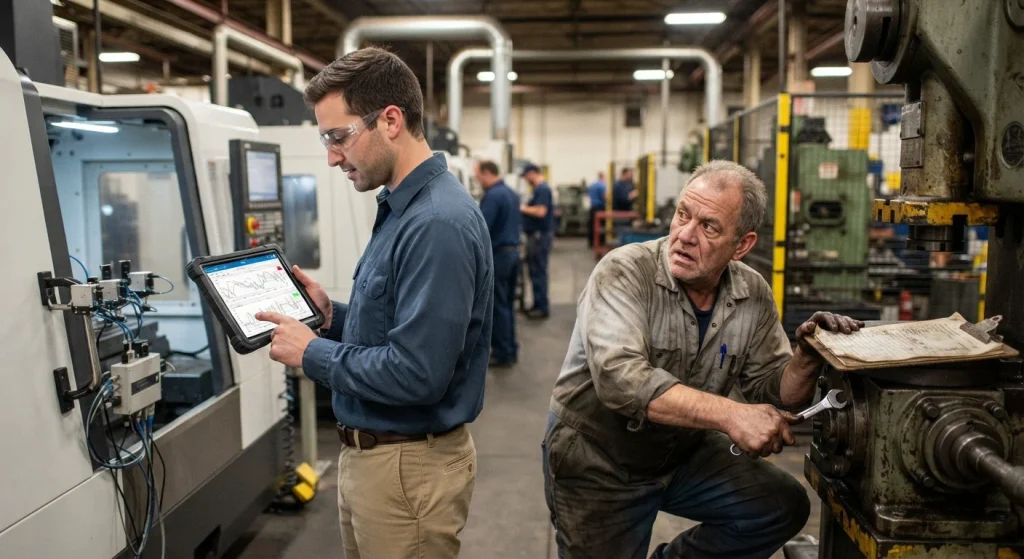
AI predictive maintenance cuts unplanned downtime when the plant already collects clean machine data and acts on the alerts it produces. Models trained on vibration, temperature, current draw, and PLC tag history flag a failing spindle or pump days before it stops. Siemens reports that companies using predictive maintenance saw large drops in unplanned machine downtime and maintenance spend, though those figures come from a vendor that sells the software.
The opposing view holds up in many New Jersey plants. Older equipment often has no sensors, and retrofitting a line of legacy machines takes time and capital before any model runs. Models also throw false alarms during the first months, and maintenance teams who get burned by bad alerts stop trusting the system. For a plant running two shifts on mixed-age equipment, a disciplined preventive schedule and a CMMS used properly may deliver more than AI in year one.
Our recommendation: start with the five to ten assets whose failure stops the whole line, and prove the model there before scaling.
- Rank assets by line impact, not age. A bottleneck filler or extruder failing costs more than three secondary machines combined, so it earns sensors first.
- Collect from the historian before buying new sensors. Many plants already log PLC tags in an OSIsoft PI or Ignition historian that a model can train on today.
- Route sensor data through an OT gateway in the DMZ. Data leaves the plant floor through one controlled path rather than each device calling the cloud directly.
- Set a 90-day alert review with maintenance leads. Tuning thresholds with the people who act on them is what keeps false positives from killing adoption.
- Tie alerts to work orders in the CMMS. An alert that doesn’t create a ticket is a dashboard nobody checks.
Our AI automation services page covers how we scope these pilots. Book a downtime risk review and we will rank your line’s highest-impact assets with you.
Is Connecting Plant Equipment to AI Tools Worth the Ransomware Risk?
Connecting OT to AI tools is worth the risk only when the connection is engineered so that a breach in the office cannot reach the controllers. Plants that already monitor their OT networks recover far faster. Dragos found organizations with full OT visibility contained OT ransomware in about 5 days, against an industry average of 42. The monitoring that AI needs and the monitoring that security needs are largely the same investment.
The case against connecting is serious. Ransomware groups hitting industrial firms rose sharply in 2025, and Dragos found adversaries mapping entire control loops, from HMIs to variable frequency drives to cellular gateways. Every cloud connection, API key, and vendor integration is one more door. An air-gapped line with manual data collection has a smaller attack surface, and some plant managers reasonably choose that trade.
Our recommendation: connect, but never directly, and never before segmentation and backups are tested.
- Segment IT and OT using the IEC 62443 zone and conduit model. Each production cell becomes its own zone, so ransomware in one cannot spread across the floor.
- Put an industrial DMZ between the plant and the business network. Historians, AI gateways, and patch servers live there, and nothing routes straight from email to a PLC.
- Replace always-on vendor VPNs with brokered, time-limited remote access. Sessions are approved, recorded, and closed when the OEM finishes the job.
- Enforce phishing-resistant MFA (FIDO2 keys) for engineering accounts. Dragos observed attackers extracting Active Directory credentials as a stepping stone toward OT networks.
- Keep immutable, offline backups of PLC logic and HMI projects. Restoring a controller program from a known-good copy is what turns a multi-day outage into hours.
- Monitor OT traffic passively. Tools that read Modbus/TCP, EtherNet/IP, and S7 traffic spot reconnaissance without touching the controllers.
If your plant runs defense work, these same controls map directly to CMMC compliance requirements. Ask us for an OT segmentation assessment before your next AI pilot goes live.
Should a New Jersey Plant Build AI and OT Skills In-House or Use a Managed Partner?
Most New Jersey manufacturers with 100 to 1,000 employees get further, faster with a managed IT partner that already runs OT monitoring and AI integration. The skills involved span network engineering, industrial protocols, security operations, and data pipelines. Hiring one person for each is out of reach for most mid-sized plants, and one generalist cannot cover all of it around the clock.
The in-house argument is strong in some plants. Internal engineers know the process, the quirks of each line, and which alarms matter. Outside providers can treat OT like office IT, pushing patches or scans that crash a controller. Plants with a mature controls team and an existing SOC may only need tools, not a partner.
Our recommendation: keep process knowledge in-house and hand the 24/7 monitoring, backup, and integration work to a partner who has done it on a plant floor before.
- Ask any provider how they patch OT. The right answer involves maintenance windows, vendor-approved patches, and testing on a spare, never auto-update.
- Require a named escalation path to your controls engineer. Alerts should reach the person who can stop a line safely, not just the IT help desk.
- Check for local, on-site response. A Fairfield or North Jersey team can be on the floor the same day when remote fixes fail.
- Get the runbook in writing. You should own a documented recovery plan for every HMI, PLC, and historian, whoever operates it.
The Plants That Win Fix the Network Before They Buy the Model
New Jersey manufacturers that reduce downtime with AI do it in a set order: they segment the plant network, back up every controller program, lock down vendor access, and only then feed machine data to a predictive model on their most critical assets. Skip the first three steps and AI becomes one more way for ransomware to reach the line, in a sector that already accounts for most industrial ransomware victims. Follow the order and the same sensors, gateways, and monitoring that power predictive maintenance also shorten recovery when something does go wrong, which turns AI from a pilot project into a measurable cut in lost production hours.
If your plant is planning an AI pilot or recovering from an outage that started in IT, schedule a manufacturing downtime assessment with our New Jersey team and get a ranked plan for your line.