

Cybersecurity Orlando FL comes down to one thing most buyers never test before they sign: whether the provider can defend the specific systems your business runs, at the hour an attack actually lands. Most Cybersecurity Orlando firms shopping for a security partner compare price and a feature list, then discover the real gaps during an incident. We have walked into that exact situation more times than we would like. This guide names the five evaluation gaps we see local buyers miss, and gives you the questions that close each one before it costs you a breach, a compliance finding, or a week of downtime.
The Five Things Orlando Buyers Get Wrong
Cybersecurity Orlando businesses evaluating services tend to buy on the wrong signals, and the pattern is consistent across the accounts we take over. Here are the five principles that separate a provider who protects you from one who just monitors you:
- Coverage hours matter more than the tool stack. An attacker times ransomware for Friday at 6 PM. If your provider answers Monday, the tools did not help.
- Compliance scope drifts. Florida healthcare, defense contractors, and financial firms carry rules that a generic security package quietly leaves out.
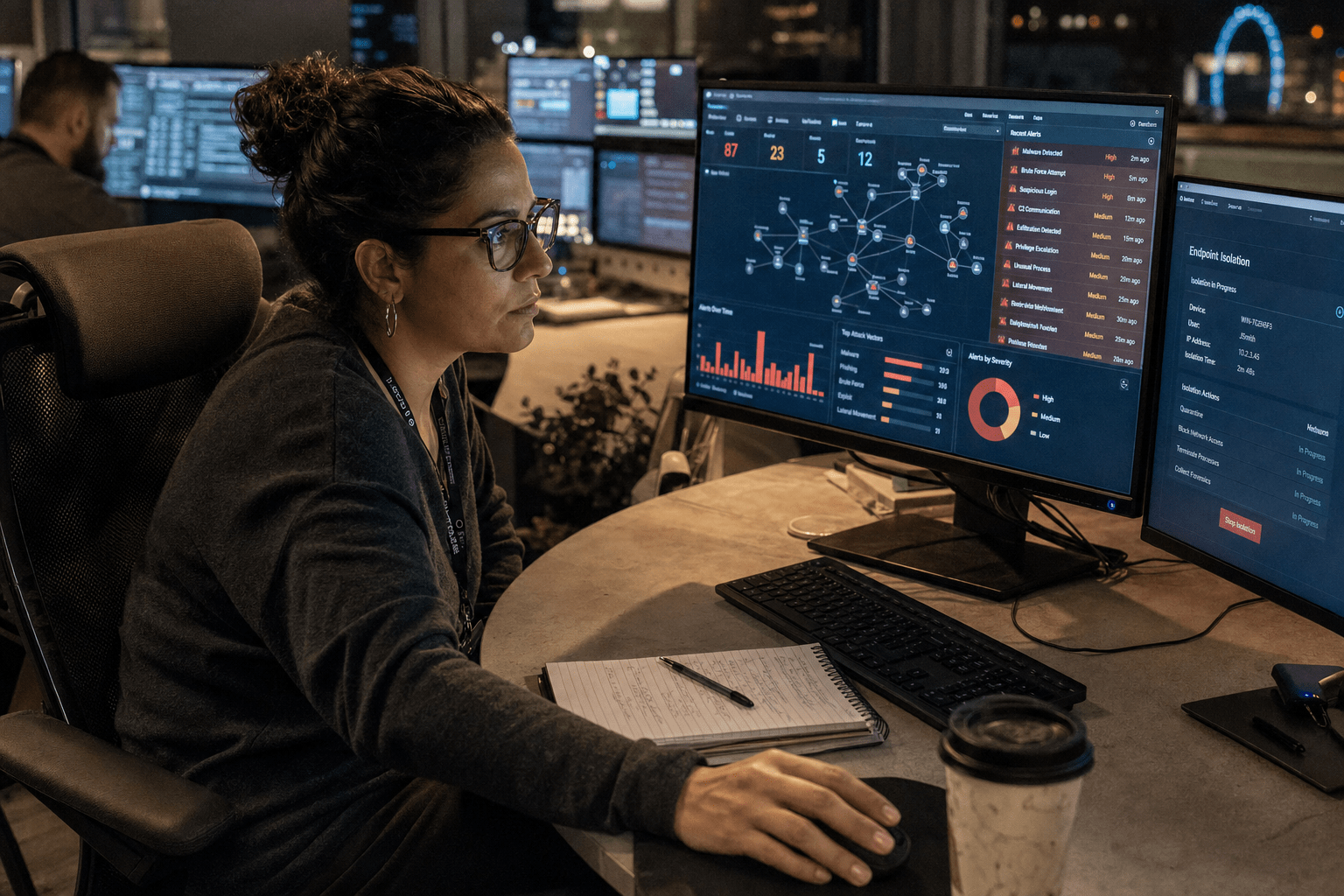
- Detection without response is theater. A dashboard full of alerts nobody acts on is a liability, not a defense.
- Local presence is an incident-response asset, not a slogan. When you need hands on hardware in Orlando, remote-only providers stall.
- The contract defines your risk. Response-time commitments, ownership of your data, and exit terms decide what actually happens under pressure.
Read those as a scorecard. If a provider you are evaluating cannot speak plainly to all five, you have found your gap.
Why Generic Cybersecurity Fails Orlando Businesses
Orlando businesses need cybersecurity built for Florida’s threat reality, not a national template applied by rote. The Cybersecurity and Infrastructure Security Agency has tracked a steady rise in ransomware against state and local governments, hospitals, and small businesses, and Florida sits squarely in that pattern. We have seen Central Florida healthcare practices, municipal offices, and mid-market service firms hit by the same playbook: a phished credential, a quiet dwell period, then encryption over a weekend.
The reason generic packages fail is that they are priced to a lowest common denominator. They deliver antivirus, a firewall, and a monthly report, then call it a security program. That covers the compliance checkbox and none of the actual attack surface. An Orlando manufacturer with legacy operational technology, a Winter Park medical group under HIPAA, and a downtown law firm holding privileged client files each face a different threat model. One package cannot serve all three well.
Our approach starts from the systems you run and the rules you answer to. That is the difference between cybersecurity services scoped to your business and a subscription that looks like security on paper.
Do You Have After-Hours and Weekend Coverage?
Real cybersecurity Orlando FL means someone is watching and able to respond at 2 AM on a holiday, because that is when attackers move. The argument for 24/7 coverage is straightforward: dwell time is the enemy, and every hour an intrusion sits undetected raises the cost. Most breaches we respond to began outside business hours precisely because the attacker knew the monitoring went dark.
The counterargument buyers raise is cost. Round-the-clock staffing sounds expensive, and for a small firm it can feel like insurance against a low-probability event. That is a fair concern, and not every business needs a fully staffed 24-hour SOC of its own. The honest middle position is this: you need continuous monitoring with a defined after-hours response path, whether that is delivered by your provider’s security operations team or a shared model. What you cannot accept is a gap where alerts pile up unread until the next business day. Ask any provider for their exact after-hours escalation flow, in writing.
Does the Provider Understand Your Compliance Obligations?
Cybersecurity Orlando for businesses in regulated industries must map controls to the specific framework you answer to, not a generic best-practices list. A Central Florida healthcare provider lives under the HIPAA Security Rule. A defense subcontractor near the Space Coast faces CMMC and NIST SP 800-171. A financial services firm carries its own examinations. Each demands documented, auditable controls, not just working ones.
The case for a compliance-aware provider is that security and compliance overlap but are not the same. You can be reasonably secure and still fail an audit for missing documentation, and you can pass an audit and still be exposed. The counterpoint some buyers make is that they will handle compliance internally and just want the technical defense. That works only if the two efforts stay coordinated, which they rarely do without deliberate structure. The practical answer is to insist your security partner maps its work to your framework using the NIST Cybersecurity Framework as the common language, and produces the evidence your auditor will ask for. Our cybersecurity compliance work exists for exactly this reason.
Can They Respond, Not Just Detect?
Detection is only half of cybersecurity Orlando FL; the half that saves you is a rehearsed response that contains an incident before it spreads. The pro-detection argument is real: you cannot respond to what you cannot see, so visibility comes first. Endpoint detection and a monitored SIEM are table stakes.
The opposing reality is that visibility without action is where most programs quietly fail. We have taken over accounts with beautiful dashboards and no runbook, where an alert fired correctly and then sat for hours because no one owned the next step. Holding both sides honestly, the answer is that detection and response are a single capability, not two products. Ask your provider to walk you through a live containment scenario: who isolates the endpoint, who notifies you, what the target time-to-containment is, and how they handle an active cybersecurity emergency. If the answer is vague, the response capability is too.
What Local Presence Actually Buys You
A local Orlando cybersecurity partner shortens the distance between an incident and boots on the ground, which matters when remediation needs physical access. The value is not the office address. It is the response profile. When a compromised server needs to be pulled, when an on-site forensic image is required, or when a phished executive needs a same-day walkthrough, a provider with people in Central Florida moves faster than a remote-only vendor routing tickets through a national queue.
The fair counterargument is that most security work is remote, and cloud-first firms may rarely need anyone physically present. True. If your entire stack lives in Azure or AWS and you have no on-premise footprint, geography matters less. Even then, local presence carries a softer benefit: a partner who knows the Orlando business community, the regional threat activity, and your team by name tends to be a more responsive partner. Weigh it against your actual environment rather than treating it as either mandatory or irrelevant.
How to Vet an Orlando Cybersecurity Provider
Vetting cybersecurity Orlando FL is a due-diligence exercise, and the contract is where the promises either hold or fall apart. Before you sign, put these on the table and get answers in writing:
- Response-time commitments. Not “we respond quickly.” A defined time-to-acknowledge and target time-to-containment, tied to severity.
- Data ownership and portability. You own your logs and data, and you can take them if you leave. Confirm the exit process on day one.
- Scope boundaries. Exactly which systems, endpoints, and cloud tenants are covered, and what is explicitly out of scope.
- Reporting cadence and readability. A monthly report your leadership can act on, not a raw alert dump.
- Framework alignment. The controls map to your compliance obligation, with the evidence trail your auditor needs.
We publish practical cybersecurity resources that go deeper on several of these, and we would rather you ask hard questions of any provider, including us, than sign on price alone.
Frequently Asked Questions
How much does cybersecurity in Orlando FL cost?
Cybersecurity pricing in Orlando depends on your environment size, compliance obligations, and required coverage hours, so a flat number is misleading. A small firm needing monitoring and endpoint protection sits at a different tier than a regulated healthcare group requiring documented controls and 24/7 response. The honest way to price it is a scoped assessment of your actual attack surface, which is where a free strategy call starts.
What industries in Orlando need managed cybersecurity most?
Healthcare, defense and aerospace subcontractors, financial services, legal, and hospitality carry the highest exposure in the Orlando market. Each holds sensitive data and answers to specific regulations, which makes them frequent ransomware and phishing targets. Any business handling customer payment data or protected records should treat managed cybersecurity as a baseline, not an upgrade.
Do small businesses in Orlando really get targeted by cyberattacks?
Yes, and often more than large enterprises, because attackers assume smaller firms have weaker defenses. CISA has repeatedly flagged small and mid-sized businesses as primary ransomware targets. The assumption that you are too small to matter is exactly the gap attackers exploit.
What is the difference between IT support and cybersecurity in Orlando?
IT support keeps your systems running; cybersecurity keeps them defended, and the two require different disciplines. A general IT provider may manage your network and help desk without the threat detection, incident response, and compliance depth a security program demands. Some providers offer both, but confirm the security capability is real and staffed, not a bolt-on.
How fast should an Orlando cybersecurity provider respond to an incident?
A capable provider commits to acknowledging a critical incident within minutes and containing it within a defined, severity-based window, not “as soon as possible.” Speed of containment is the single biggest factor in limiting breach cost. If a provider will not put a response-time commitment in the contract, treat that as the answer.
Talk to an Orlando Cybersecurity Team That Responds
The gap between a provider who monitors you and one who protects you shows up under pressure, not in the sales deck. Every Orlando business we work with came to us either shopping deliberately or recovering from the moment a generic package failed them. The five gaps in this guide, coverage hours, compliance scope, real response capability, local presence, and contract terms, are the ones that decide which side of that line you land on. You do not need to guess where you stand. We will look at your actual environment, map it against your compliance obligations, and tell you plainly where the exposure is. Book a free strategy call, and we will start with the systems you run and the threats aimed at them, not a template.

