

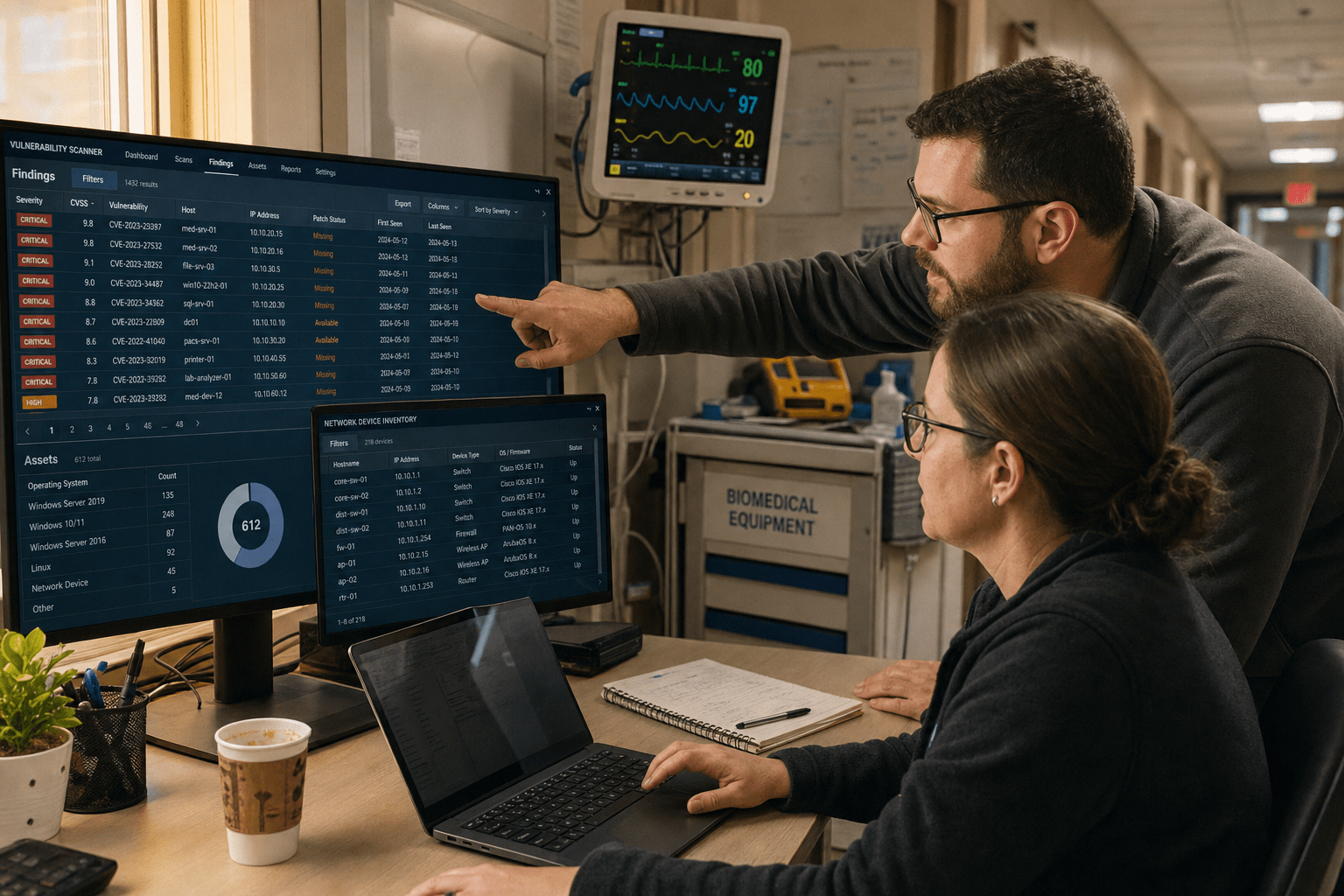
Healthcare vulnerability scanning is the recurring, evidence-producing practice of probing every system that stores or moves electronic protected health information for known weaknesses, then triaging and closing those weaknesses on a documented clock. In a small practice it is not a tool purchase. It is a scan scope, a credential strategy, a cadence that reacts to change, a safe method for clinical hardware, and a remediation record an auditor can read. Our team reviews these programs constantly, and the tooling is almost never the failure point. The failure sits in how the scan is run and what happens to the findings afterward. Seven gaps show up again and again in practices under 500 employees.
Why Healthcare Vulnerability Scanning Fails Before the First Scan Runs
Healthcare vulnerability scanning fails in small practices for reasons that are procedural, not technical, and most of them are set before anyone clicks Scan. Here are the seven we find most often, in the order they usually bite:
- Unauthenticated scans presented as an assessment. An outside-in scan sees a fraction of what a credentialed scan sees, so the report reads clean while the endpoints stay exposed.
- A calendar cadence with no change trigger. A twice-yearly scan says nothing about the firmware you pushed last Tuesday or the new EHR module that went live in March.
- Clinical and biomedical hardware handled wrong. Practices either scan it actively and disrupt care, or exclude it permanently and lose sight of the riskiest segment they own.
- No triage tied to clinical impact. When every finding is urgent, nothing is urgent, and the queue grows until the team stops opening it.
- Remediation windows that exist only on paper. A policy promising 30-day closure with no closure evidence is worse than no policy, because it documents your own non-compliance.
- Scan reports filed as the risk analysis. A findings list is an input to a risk analysis. It is not the analysis, and reviewers know the difference immediately.
- Scope that stops at the office wall. Remote clinicians, home endpoints, and business associate connections sit outside the scan while sitting squarely inside the ePHI path.
Each of these is fixable in weeks, not quarters. The rest of this piece walks the method behind the fix. If you want the wider control picture first, our healthcare IT practice covers where scanning sits among the other safeguards.
Authenticated Versus Unauthenticated Healthcare Vulnerability Scanning
Authenticated healthcare vulnerability scanning logs into the target system with a service account and reads installed software, patch level, registry state, and local configuration, while an unauthenticated scan only probes what the host exposes to the network. The visibility difference is not marginal. On a typical 60-endpoint practice network we expect a credentialed scan to surface several times the findings of an uncredentialed pass over the same address range, because most real exposure lives in unpatched local software rather than open ports.
What an unauthenticated scan actually proves
An unauthenticated scan proves what an attacker sees from the outside before they hold any credential, which makes it a legitimate perimeter test and a poor internal inventory. We keep them in the rotation for exactly that reason. They validate segmentation, catch a firewall rule someone opened for a vendor and forgot, and confirm that the guest wireless cannot reach the clinical subnet. The counter-argument deserves a hearing: some security leads argue uncredentialed scanning is the more honest simulation of an attacker, since real intrusions rarely begin with a domain admin token. That holds for the first hour of an intrusion and stops holding after it. Once an attacker phishes one front-desk account, they see what a credentialed scan sees, which means an uncredentialed report describes a threat model you have already lost. Both views have a place. Only one of them tells you your patch debt.
Where credentialed scans earn their keep
Credentialed scanning earns its keep on the workstations and servers that touch charts, imaging, and billing, because that is where unpatched third-party software accumulates quietly. PDF readers, Java runtimes, imaging viewers, and dental or optometry practice-management clients rarely sit in the same patch process as the operating system. A credentialed scan finds them. The tradeoff is real and worth stating plainly: you are creating a privileged account that reaches most of your estate, and that account becomes a target. We treat the scan credential as tier-zero, vault it, scope it to read-only where the scanner supports it, disable interactive logon, and alert on any use outside the scan window. Practices that skip those controls trade one exposure for a larger one, which is the honest case against credentialing everything by default. Our vulnerability assessment work treats the credential design as part of the engagement rather than an afterthought.
Scan Cadence, Change Triggers, and Continuous Coverage
Defensible healthcare vulnerability scanning cadence combines a fixed interval with change-triggered scans, because a calendar alone cannot see the work your team did between dates. The proposed HIPAA Security Rule updates push toward scanning at least every six months and annual penetration testing for covered entities and business associates regardless of size, which sets a floor. Treating that floor as the program is where small practices get caught.
Which changes should trigger an off-cycle scan
Five changes should pull a scan forward, and none of them are rare. A firmware or operating-system upgrade on anything in the ePHI path. A new device class joining the network, including a single loaner imaging unit. Any change to a firewall rule, VPN profile, or segmentation boundary. An EHR or practice-management version jump, which routinely re-enables a service the prior version had closed. And any vendor remote-access session, because the session ends but the tunnel configuration often survives it. We wire these into change management so the scan request is generated by the change ticket rather than remembered by a person. That single automation does more for real coverage than doubling the scan frequency, and it produces the timeline evidence reviewers want. The relationship between periodic testing and patch discipline is worth reading alongside this, which our piece on testing, patching, and vulnerability scanning covers in more depth.
Where continuous monitoring replaces the scan window
Continuous agent-based monitoring reports exposure as it appears rather than at intervals, and for workstation fleets it has largely won the argument. Agents catch the laptop that was asleep during the scan window, which is the single most common blind spot in a practice with part-time clinicians. The opposing view is fair: agents add software to every endpoint, consume a maintenance budget of their own, and cannot be installed on the closed clinical hardware where risk concentrates. So the practical answer is layered rather than either-or. Agents cover the fleet, scheduled network scans cover the unagentable, and network security monitoring watches the segments where neither can run safely.
Scanning Clinical and Biomedical Devices Without Disrupting Care
Clinical device scanning should default to passive discovery, with active scans permitted only inside a maintenance window agreed with whoever owns the equipment. This is the part of healthcare vulnerability scanning where a mistake has patient consequences rather than paperwork consequences, and it is the reason many practices quietly exclude the clinical VLAN and never revisit it.
Why active probes put clinical hardware at risk
Active scanning sends crafted traffic at a target and waits for a response, and embedded clinical devices frequently mishandle traffic their firmware never anticipated. Infusion pumps, older imaging modalities, and monitoring gateways have well-documented histories of hanging, rebooting, or dropping their network session under aggressive port and service enumeration. A rebooting device during a procedure is not an IT incident. So the exclusion instinct is understandable, and it is still wrong, because these devices run the oldest operating systems in the building and sit closest to the patient. The resolution is method, not avoidance: identify the segment passively, then earn active coverage device by device.
Passive discovery plus windowed active scanning
Passive discovery reads traffic already crossing a span or mirror port and builds a device inventory with manufacturer, model, protocol, and often firmware version, without sending a single packet at the device. It gives real coverage of the clinical segment at effectively zero clinical risk, and for many practices it is the only method that will ever be approved there. Where an active scan is genuinely needed, we schedule it against a documented downtime window with the biomedical owner present, throttle the scan rate, and start with one representative unit rather than the whole class. That sequencing keeps the risk contained and produces a written record of the decision. Strong segmentation makes the whole question easier to manage, which is why we treat it as prerequisite work and cover it in network segmentation for ePHI. How that segment is built also shapes where encryption has to carry the load, a tradeoff we walk through in our look at hidden ePHI encryption risks.
Triage and Remediation Windows That Survive Review
Healthcare vulnerability scanning produces value only when findings move through a triage model with named owners and a remediation clock, and most small-practice programs stall precisely here. A scanner will hand a 60-endpoint practice hundreds of findings on the first credentialed run. Without triage that volume reads as noise, and the queue becomes evidence of neglect rather than diligence.
Severity scoring that reflects clinical reality
Raw severity scores rank a finding by technical exploitability, not by what the affected system does in your building. We re-rank on two factors the scanner cannot know: whether the host touches ePHI, and whether the host is reachable from a user-facing segment. A high-severity finding on an isolated lab device with no route to the internet ranks below a medium-severity finding on the front-desk workstation that reads charts all day. The objection to re-ranking is that it invites convenient downgrades, and that objection has teeth. We answer it by requiring the reason for every re-rank to be written into the record, so a downgrade is a defensible judgment rather than a quiet edit.
Remediation windows and documented accepted risk
Set windows you can actually meet, then prove closure with a follow-up scan rather than a status field. In practices this size, 15 days for the top tier, 30 for the next, and 90 for the remainder is usually achievable with the staff on hand. Some findings will not close, because the fix requires a vendor patch that does not exist or a device the practice cannot replace this fiscal year. That is acceptable when it is documented as accepted risk with a compensating control, a review date, and a signature. It is not acceptable when it is silence. The same discipline applies across the wider control set, which our review of HIPAA Security Rule compliance mistakes covers from the policy side.
How Scan Evidence Feeds the HIPAA Risk Analysis
Scan output is an input to the HIPAA risk analysis, and the analysis is the artifact a reviewer actually asks for. This is the seventh gap and the most expensive one, because a practice can run flawless scans for two years and still fail review by filing the reports as the assessment. The scan tells you what is vulnerable. The risk analysis states, for each identified weakness, the threat, the likelihood, the impact on confidentiality and availability of ePHI, the control in place, and the decision made. Our IT risk assessment work exists to close that translation gap, and the annual-cycle mistakes we see most often are collected in annual HIPAA security risk assessment mistakes.
Scope is the other half. A risk analysis covering only the office network while clinicians chart from home describes a practice that no longer exists. Remote endpoints, personal devices where permitted, and business associate connections belong inside the scan boundary, which is where a hardened secure workspace for healthcare teams does the heavy lifting. When we rebuilt the environment for a Louisiana provider, getting scan scope and evidence aligned was what made the compliance story hold together, and that work is written up in our healthcare IT modernization case study.
Frequently Asked Questions
How often should a small healthcare practice run vulnerability scans?
Scan at least every six months to meet the emerging regulatory floor, and pull a scan forward whenever a change touches the ePHI path. Most practices we work with settle on quarterly credentialed scans plus continuous agent coverage on workstations, with change-triggered scans generated automatically from the change ticket.
Does HIPAA require vulnerability scanning?
The current Security Rule requires a risk analysis and does not name scanning as a discrete control, while the proposed updates make scanning explicit at a six-month interval with annual penetration testing. In practice, reviewers have expected scanning as evidence supporting the risk analysis for years, so the proposed language formalizes existing expectation rather than creating new work.
Is vulnerability scanning the same as penetration testing?
No. Scanning is automated detection of known weaknesses at scale, while penetration testing is human-led exploitation that proves what an attacker could chain together. Both are expected under the proposed rule, and we break down the difference in our comparison of vulnerability scanning versus penetration testing.
Can vulnerability scanning break medical devices?
Active scanning can disrupt embedded clinical hardware, which is why we default to passive discovery on clinical segments and run active scans only in an agreed maintenance window with the equipment owner present. Excluding those devices entirely is the more common and more dangerous choice, since they typically run the oldest software in the building.
Who should own the remediation queue in a practice without a security team?
Assign a named clinical-operations or practice-manager owner for decisions and an IT partner for execution, because an unowned queue never drains. The owner does not need to be technical. They need authority to approve downtime windows and to sign off on accepted risk.
Talk Through Your Scanning Program With Our Team
Healthcare vulnerability scanning goes wrong in the same seven places in almost every small practice we assess, and none of them require a bigger tool budget to fix. They require a credential strategy, a cadence wired to change, a safe method for clinical hardware, a triage model with owners and clocks, and a clear line from scan output into the risk analysis. Practices that get those five right stop rediscovering the same exposure every six months and start showing a closure record that holds up under review. If you are not confident your current scanning would survive that review, book a free strategy call and we will walk your scope, cadence, and evidence trail with you, then tell you plainly where the gaps are.

