

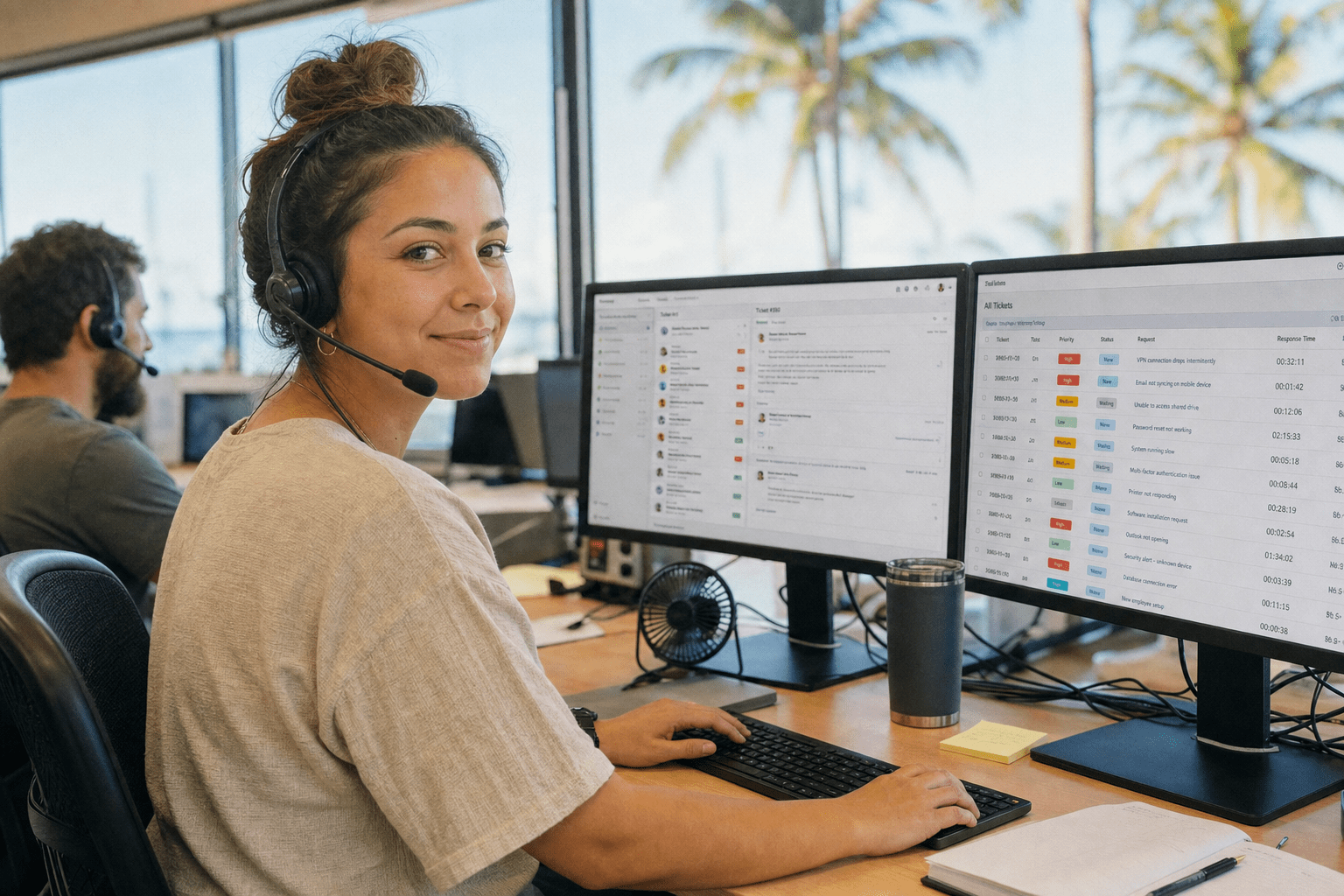
Help Desk Support Services Florida may look interchangeable from the outside, with providers across the state promising the same 24/7 coverage and fast response. But a Florida small business has two needs that a generic help desk was never built for, and both get exposed at the worst possible times. The first is coverage that actually holds through storm season, when support tickets spike, staff shift to working from home, and the phones a distant call center relies on may be down. The second is support that scales across Florida’s spread-out metros without turning your team into a ticket number. This guide walks through what a Florida SMB should actually demand from a help desk, so you buy support that works on the hard days, not just the easy ones.
What Help Desk Support Should Deliver
Help Desk Support Services Florida should give your team one dependable place to turn and resolve most technology issues before they become major interruptions. That covers the daily friction, password resets, email trouble, connection drops, software that fails, plus the judgment to know when a routine ticket is actually something more serious. The difference between providers is rarely visible in the marketing and almost always in how the service is built. Our help desk and IT support work is structured around resolving issues on first contact wherever possible, because a ticket that bounces from person to person is a ticket that costs a Florida business its afternoon.
Resolution Rate Beats Response Time
The most important metric for Help Desk Support Services Florida is how many issues are resolved on first contact, not simply how quickly someone answers. A help desk can post excellent response numbers by logging your ticket quickly and letting the real problem sit for hours. Response time tells you when you reach a human. Resolution rate tells you when your problem goes away. The fair counterpoint is that some issues genuinely require escalation and cannot close in one call, which is true. But a help desk built to resolve treats escalation as an exception, while one built to log treats it as the default. Ask any Florida provider for their first-contact resolution rate, and treat a vague answer as an answer.
A Response SLA You Can Hold Them To
The response-time service level agreement is where a 24/7 promise gets real, because being reachable at 2 a.m. means little if the guaranteed response to an urgent issue is four hours away. A meaningful SLA states response times by priority, defines what counts as urgent, and says what happens when the provider misses. For a Florida SMB, the SLA is also where you find out how the provider behaves during a regional event, when everyone is filing tickets at once. Read that language before you sign, because the difference between a one-hour and a four-hour urgent response is the difference between a blip and a lost day.
The Florida Factor: Storm Season and Spread
The Florida factor in help desk support is the combination of hurricane season and a state spread across many distant metros, and it is exactly what a national script leaves out. During a named storm, three things happen to your support needs at once: ticket volume climbs, your staff scatter to home offices or evacuate, and local infrastructure gets shaky. A help desk that depends on a single call center and never planned for a regional surge is a help desk that goes quiet when you need it most. The federal Ready.gov business guidance is direct that continuity planning has to account for the disruptions your region actually faces, and in Florida that means storm season is a scheduled stress test for your support, not a rare surprise.
Coverage That Holds Through Storm Season
Coverage that holds through storm season is the demand most Florida buyers forget to make until the season is on top of them. The question to ask a provider is concrete: when a hurricane hits the state and your ticket volume triples while staff work remote, how does your help desk stay reachable and staffed. A provider with distributed coverage and a real 24/7 emergency help desk can absorb that surge. One that routes everything through a single site cannot promise the same. The counterview that storms are infrequent enough to plan around loosely does not survive contact with a real season, where the disruption is annual and the timing is the only unknown.
Support That Scales Across Florida’s Metros
Help Desk Support Services Florida must scale across the state’s major metros to serve offices and remote employees in cities such as Orlando, Tampa, Boca Raton, and Miami. The strength of a good Florida provider is covering the whole state while still giving each client a team that learns their environment. The risk on the other side is a large provider that scales by treating you as a number, where every call starts from zero. The balance you want is statewide reach with a consistent team, which is what separates real managed IT support across Florida from a call center that happens to have Florida clients.
Security Signals Come Through the Help Desk
Security must be built into Help Desk Support Services Florida because suspicious emails, access problems, and unusual device behavior often surface through support tickets first. A suspicious email, an account that will not log in, a device acting strangely, these arrive as ordinary tickets and can be the first sign of an attack. A help desk trained to recognize and route those signals adds early detection that a purely technical support line misses. The CISA cybersecurity best practices and the NIST Cybersecurity Framework both stress that early detection depends on the people closest to users spotting what they see. During storm season, when attackers exploit the chaos, that vigilance matters even more.
Questions to Ask a Florida Help Desk Provider
Before you commit to a help desk in Florida, a handful of direct questions cut through the sameness fast. What is your first-contact resolution rate. What is your written response-time SLA for urgent issues. How does your coverage hold up during a hurricane when ticket volume spikes and staff go remote. Do you cover our locations across the state, and do we get a consistent team that learns our systems. How do you handle a ticket that turns out to be a security concern. The providers who answer these plainly are usually the ones worth shortlisting, and the ones who deflect are telling you how a real emergency will go. For a broader view of the market, our roundup of reliable managed IT support companies in Florida is a useful starting point, and if the model itself is new to you, how a managed help desk works explains the fundamentals.
Frequently Asked Questions
How much does help desk support cost in Florida?
Help desk support in Florida is typically priced per user per month or bundled into a managed IT agreement, and the right number depends on your headcount and how much support your team needs. Focus on the value the SLA and resolution rate deliver rather than the lowest price, since a cheap help desk that leaves issues unresolved costs more in lost productivity, especially during a busy storm season.
Does storm season really affect help desk support?
Yes, significantly. During hurricanes, ticket volume rises, staff shift to remote work, and local infrastructure can fail, all at once. A help desk that never planned for a regional surge can become unreachable exactly when you need it. Ask any Florida provider directly how their coverage holds up during a storm before you rely on them.
Can one help desk cover offices across multiple Florida cities?
A strong statewide provider can, while still giving each client a consistent team. Florida’s metros are spread out, so the goal is a help desk with reach across the state that does not treat you as an anonymous ticket. Confirm that the provider covers all your locations and assigns a team that learns your environment.
What is the difference between a help desk and managed IT?
A help desk handles reactive, day-to-day support, while managed IT adds proactive monitoring, security, and planning on top. Many Florida SMBs start with help desk support and grow into full managed IT. The help desk is the piece your team interacts with daily, so its quality shapes your whole experience of IT.
How fast should a Florida help desk respond to urgent issues?
Look for a written SLA guaranteeing an urgent response within an hour, with clear priority levels and defined consequences for a miss. A general promise of fast service is not enforceable. The response time you can actually rely on is the one committed to in the agreement.
Get Help Desk Support Built for Florida
Choosing help desk support in Florida means looking past a market that markets itself in identical language and asking what happens on the hard days. The providers worth your time will show you a real first-contact resolution rate, commit to a response SLA in writing, prove their coverage holds through storm season when tickets spike, cover your locations across the state with a team that knows you, and treat security signals as more than routine tickets. Those are the differences you feel during a hurricane, not on a quiet Tuesday. If you want a help desk that resolves issues, scales across Florida, and stays reachable when the season turns, our team supporting businesses statewide will review your current setup, show you where support falls short, and lay out what stronger looks like. Book a free strategy call and we will start with the storm-season question your current provider has probably never answered.

