

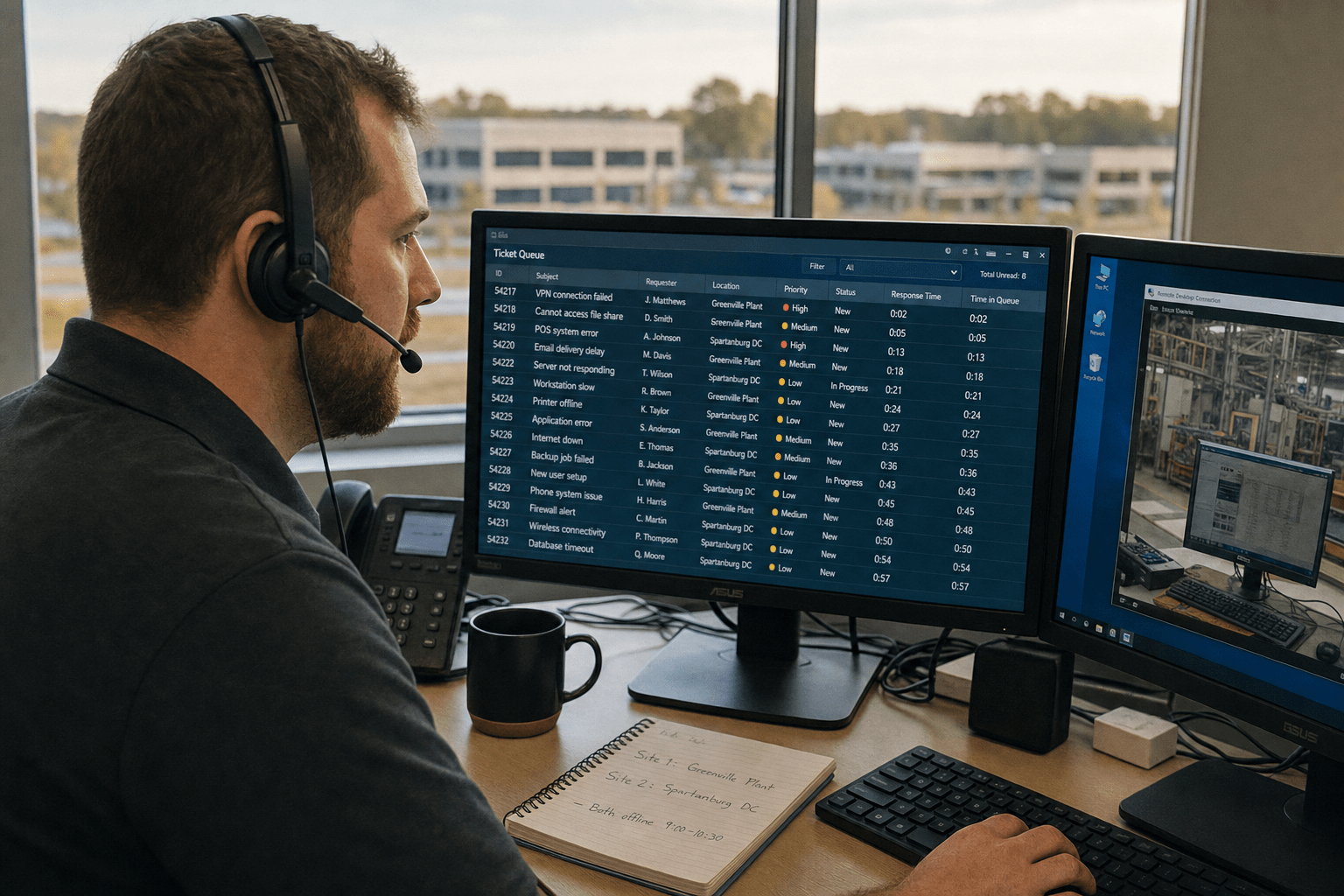
Choosing an IT Help Desk South Carolina provider comes down to response speed, technician quality, coverage hours, and the ability to support staff across the state. Small and midsize firms here often shop on monthly price and find the gaps later, usually when a plant on second shift goes down or a satellite office cannot get help. We have run support desks for South Carolina businesses for years, and the state’s shape sets the bar. Work here spans the Upstate, the Midlands, and the Lowcountry, and a lot of it runs on manufacturing shifts, so multi-site reach and off-hours coverage decide whether a help desk earns its keep.
The 5 Questions to Ask Before You Buy
An IT Help Desk South Carolina service works best when it is matched to how your business operates rather than selected by price alone. These five questions separate a desk that helps from one that frustrates.
- What is the real response time? A promise to answer “fast” means nothing. Ask for the average time to first human contact and the target to resolve.
- Who answers the ticket? A technician who already knows your setup resolves faster than a scripted queue starting from zero.
- When does coverage run? Business hours, extended hours, or true 24/7 changes both price and value. Match it to your real shifts.
- Can it cover multiple sites? A firm with an Upstate plant and a Charleston office needs a desk that treats both as first-class.
- How is it priced? Per user, per device, or per ticket each rewards different behavior. Know what you are paying for.
Why Help Desk Support in South Carolina Turns on Response Time
IT Help Desk South Carolina lives or dies on response time, because every minute a system stays broken is a minute your people cannot work. A support desk exists to remove friction, so the gap between a ticket opening and a technician engaging is the number that matters most. The federal NIST guidance on IT service management treats responsiveness and measurable service levels as the backbone of a reliable support function, and that holds whether you run a law office in Columbia or a shop floor in Spartanburg.
There is a fair counterpoint. A desk that answers instantly but never fixes the root cause just reopens the same ticket, so raw speed is not the whole picture. The honest measure pairs first-response time with first-contact resolution, the share of issues solved without a callback. A good managed help desk tracks both and shows you the numbers, rather than hiding behind a vague promise to be quick.
How Ticket Response Time Should Be Measured
Ticket response time should be measured against a written service level, not a slogan, because a number you can hold a provider to is the only one that protects you. A service level agreement states the target time to first human response and to resolution, sorted by how urgent the issue is. A password reset and a production line stopped by a dead server are not the same emergency, and a serious desk staffs for that gap.
The opposing view is that rigid targets can push a desk to close tickets fast to hit a metric, at the cost of solving the real problem. That risk is genuine, which is why the agreement should measure resolution quality next to speed. We build our IT support commitments around both, so the desk is rewarded for fixing an issue once rather than closing it and hoping it stays closed.
How Co-Managed Support Fits Growing SC Firms
Co-managed support fits a growing South Carolina firm that already has some in-house IT but needs more hands, because it adds capacity without replacing the people who know the business. In a co-managed model, your internal staff keeps the work they do well while the outside desk absorbs overflow, after-hours tickets, and specialized problems. Many SC manufacturers and mid-sized firms run this way rather than choosing between a lone internal technician and full outsourcing.
The other side is that co-management adds a coordination cost, since two teams have to share tools and avoid stepping on each other. For a very small firm with no internal IT, full outsourcing is simpler and cheaper. For a company with one or two internal people stretched thin, though, co-management usually beats both hiring another full-timer and handing everything to an outsider. The right help desk setup depends on how much internal capability you already have.
The South Carolina Factors a National Desk Overlooks
The IT Help Desk South Carolina is that the state spreads across three distinct regions and runs heavily on shift work. Business here is not concentrated in one metro. The Upstate around Greenville, the Midlands around Columbia, and the Lowcountry around Charleston each carry their own firms, and many companies operate sites in more than one. A help desk scoped for a single office often struggles when a ticket comes from a location it treats as an afterthought.
Manufacturing sharpens the point. The Upstate corridor runs plants on second and third shifts, and a line going down at 11 p.m. costs the same as one at noon. A desk built for weekday office hours leaves those shifts unsupported, which for a manufacturer is where the real risk sits. Our 24/7 emergency IT help desk is built to answer at the hours production actually runs, not just when the front office is open.
How Multi-Site Coverage Changes the Plan
Multi-site coverage changes a help desk plan because a firm operating in more than one South Carolina region needs consistent support at every location, not just the headquarters. When one site gets fast, knowledgeable help and another waits in a generic queue, the second site’s productivity suffers and its staff learn to route around the desk. Consistency across locations is what makes support trustworthy.
The counterargument is that a single-location business does not need this, and paying for multi-site capability would be waste. That is true, and we would not sell it to a one-office firm. For the many SC companies with a plant in one region and offices in another, though, uneven coverage is a daily drag. A desk that treats every site as first-class, with technicians who know each location’s setup, removes that friction.
How Storm and Outage Readiness Protects Uptime
Storm and outage readiness protects uptime because South Carolina’s coast and inland areas both face weather that can knock out power and connectivity for days. The federal Ready.gov business continuity guidance is clear that planning must account for the disruptions a region actually faces, and hurricanes and severe storms are real here, especially in the Lowcountry. A help desk with no continuity plan becomes unreachable when a storm hits, which is the worst possible time to lose support.
The opposing view is that most days are calm, so heavy continuity spending can look excessive. For a business that could absorb a few days offline, a lighter plan may be reasonable. For most, being unreachable during the one week that truly matters outweighs the routine savings. We pair help desk coverage with tested continuity so the desk holds up when the region does not.
How to Choose a Help Desk Partner in South Carolina
Choosing a IT Help Desk South Carolina means testing response time, coverage hours, and multi-site reach before you sign, not after your first bad night. Ask for real service-level numbers in writing, ask who answers and where they sit, and ask how they support a second or third location during off-shift hours. A confident provider answers each with specifics; a weak one reaches for slogans about being always on.
Then check the fit for your operation. A single downtown office and a two-plant manufacturer have different needs, and the right desk matches yours rather than a generic package. If you want a straight read on what your team actually needs and where your current support falls short, our team serves businesses across South Carolina and offers a free strategy call to map it out with no obligation to buy.
Frequently Asked Questions
How much does help desk support cost in South Carolina?
Help desk support in South Carolina is usually priced per user or per device per month, and the range depends on coverage hours, staffing model, and number of sites. Business-hours support with a shared queue sits at the low end, while 24/7 coverage across multiple locations costs more. The right price matches your real shifts and site count rather than the cheapest tier.
What response time should a South Carolina help desk guarantee?
A South Carolina help desk should guarantee a written first-response target broken out by urgency, so a stopped production line gets faster attention than a routine request. The number matters less than whether it is committed in a service level agreement you can hold them to. Pair the response target with a first-contact resolution rate to judge real quality.
Should a growing SC business choose co-managed or fully outsourced IT?
A growing South Carolina business with one or two internal IT staff usually benefits from co-managed support, which adds capacity without replacing the people who know the business. A firm with no internal IT at all often finds full outsourcing simpler and cheaper. The right choice depends on how much internal capability you already have.
Can one help desk cover multiple South Carolina locations?
Yes, a well-run help desk can cover multiple South Carolina locations, and firms with sites in different regions should insist on consistent support at every one. When one location gets fast help and another waits in a generic queue, the second site’s productivity suffers. Ask a provider how they handle multi-site coverage before signing.
Does help desk support run during manufacturing night shifts?
Help desk support can run around the clock, and for South Carolina manufacturers on second and third shifts it often needs to. A weekday-only desk leaves night production unsupported, which is exactly when a line outage costs the most. Match the coverage window to the hours your operation actually runs.
Talk to a South Carolina Help Desk Team
Help desk support in South Carolina is not a line item you pick by price, it is a service you match to how, when, and where your business runs. The firms that get this right buy for real response times, coverage that fits their shifts, and a desk that reaches every site consistently. The ones that struggle sign the cheapest plan and find the gaps during the first outage or storm. If you want a clear read on what your team needs and where your current support is thin, our team serves businesses across South Carolina and offers a free strategy call to map it out. You leave knowing your options, whether or not you ever work with us.

