

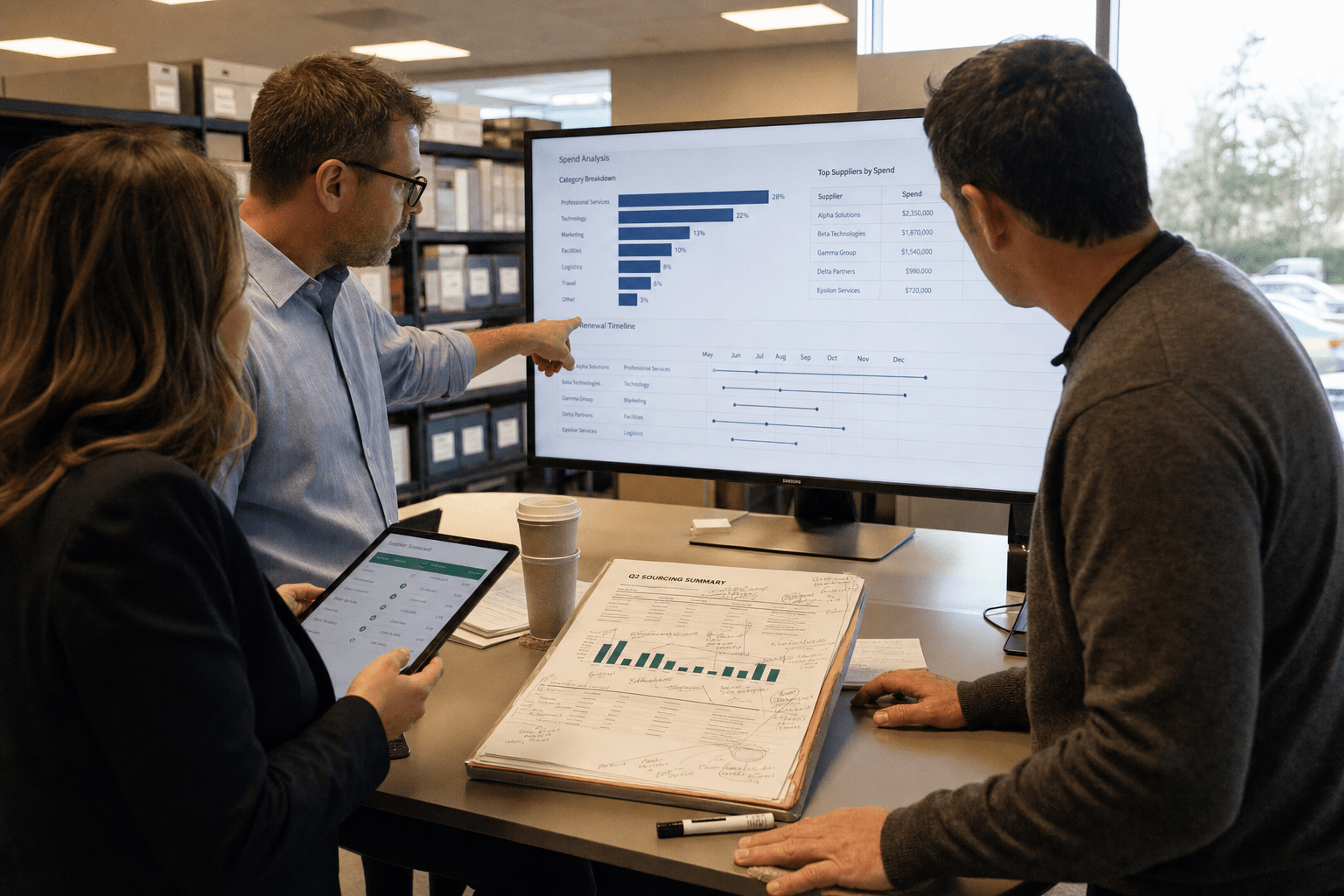
The best AI tools for procurement teams in 2026 split between full suite platforms and sharp point solutions. Coupa, SAP Ariba, Jaggaer, GEP SMART, and Ivalua cover sourcing through contract management for organizations willing to standardize on one system. Levelpath is built AI native around intake to procure. Suplari leads spend intelligence, Keelvar automates strategic sourcing events, Pactum negotiates tail spend, Inventive handles RFP response, and Tonkean orchestrates intake. Every one of them reads your supplier master and your spend history, which means the output inherits whatever that data already gets wrong. Procurement reviews everyone else’s vendors. Its own data is usually the least examined in the company.
Five Things to Settle Before You Shortlist
We put these five to procurement leaders before a platform evaluation begins, because they shape the result more than the vendor comparison does.
- Spend classification quality caps the analytics. If the same supplier appears four times under different names and half the spend sits in a miscellaneous category, no analytics platform will tell you anything you can act on.
- Intake is where savings leak, not sourcing. Purchases that never reach procurement cannot be negotiated. The measure that matters is what share of addressable spend the team actually touches.
- Full suite and best of breed is a real fork. One platform means consistent data and slower change. Point solutions mean sharper capability and integration work you own permanently.
- You own third party AI risk for the whole company. Procurement reviews the AI vendors every other function wants to buy, so the process needs to handle model training, data residency, and subprocessor questions as standard.
- Adoption depends on being easier than the alternative. If requesting through procurement is slower than an expense claim, people will use the expense claim, whatever the policy says.
Spend Analytics Inherits Every Flaw in the Vendor Master
Procurement AI is bought for insight and constrained by data hygiene, and the gap between those two is where most disappointment lives. The pattern repeats across organizations of every size. A spend analytics platform is implemented, produces a category breakdown, and the category manager immediately spots that a major supplier appears three times because the entity was set up separately for two subsidiaries and once more with a typo. A fifth of spend sits in a general category nobody classified. Purchasing card transactions are absent entirely. Intercompany charges are counted as external spend. Each is individually small and collectively fatal, because the resulting analysis cannot support a negotiation. The supplier walks into the room knowing precisely what you buy from them, and you arrive with a number your own team does not fully trust.
Fix the Supplier Master Before the Platform Arrives
Deduplicating and enriching the supplier master is the highest return preparation available to a procurement team, and it is consistently scheduled after implementation rather than before. The work is finite and mostly mechanical. Identify duplicate entities and agree a surviving record, apply consistent parent and subsidiary relationships so spend rolls up to the group you actually negotiate with, classify the long tail sitting in general categories, and decide how purchasing card and expense spend enters the picture. Most teams find a handful of suppliers account for a surprising share of the mess, so the effort concentrates quickly. Doing this first means the analytics platform starts from a defensible base, and it means the first report the CFO sees is one procurement can stand behind rather than one it has to caveat. Teams that invert the order spend their first six months explaining why the numbers look wrong.
Measure Addressable Spend Coverage, Not Sourcing Cycle Time
Procurement teams usually report cycle times and savings, and the number that predicts real influence is what proportion of addressable spend passes through the function at all. This is the uncomfortable metric because it is often low. Departments buy software directly on a card, marketing engages agencies through a relationship, and facilities renews a contract because the incumbent sent a renewal notice and nobody asked. None of that spend was ever negotiable, and none of it appears in a savings report, so the function looks efficient while the organization overpays outside its view. Establishing the coverage figure honestly, even roughly, changes the conversation with executives from cycle time trivia to a question about where the money actually goes. It also identifies exactly which intake friction needs removing, which is what makes an intake platform worth buying rather than merely worth demonstrating.
Best AI Tools for Procurement Teams by Function
The best AI tools for procurement teams divide into full suite platforms and specialists, and the right answer depends far more on your organization’s tolerance for integration work than on a feature comparison. Suite platforms give consistency and a single supplier record. Specialists give sharper capability in one area and leave the joins to you. Below is where the field currently sits.
Full Suite Source to Pay Platforms
Suite platforms suit organizations that want one system of record for supplier and contract data across the whole procurement cycle. Coupa, SAP Ariba, Jaggaer, GEP SMART, and Ivalua all cover sourcing, supplier management, contracts, and purchasing, with AI layered across intake routing, spend classification, and risk flagging. The argument for them is coherence. One supplier record, one contract repository, one place to answer what the organization has committed to, which becomes valuable the first time a supplier fails and somebody asks how exposed the company is. The argument against is speed and cost, since implementations are substantial and configuration changes usually involve the vendor. Levelpath sits deliberately apart as an AI native platform built around intake to procure rather than retrofitted onto an older architecture, combining assistants, supplier insight, and contract intelligence, and it appeals to teams that found suite implementations heavy.
Sourcing Events, Negotiation, and RFP Work
Specialist tools address the parts of the cycle where skilled time is consumed by mechanical work. Keelvar automates strategic sourcing events, running structured bidding and scenario optimization across complex award scenarios that a spreadsheet handles poorly. Pactum operates at the other end of the value curve, negotiating tail spend agreements autonomously at a volume no team could staff, which suits organizations with thousands of small suppliers nobody has ever renegotiated. Inventive AI handles RFP response, useful for teams that both issue and answer them. Tonkean orchestrates intake, sitting in front of existing systems and routing requests intelligently rather than replacing the platforms beneath. These are genuinely complementary to a suite rather than alternatives, and the sensible pattern is to fix intake first, then add negotiation coverage for the tail.
Spend Intelligence and Supplier Risk
Spend intelligence is where analysis quality depends most directly on the data work described earlier. Suplari focuses on spend analytics, surfacing patterns across categories, contract compliance gaps, and renewal exposure that manual review misses at scale. Supplier risk monitoring tracks financial health, geographic concentration, and disruption signals, which moved from a nice capability to a standard expectation after several years of supply disruption. The practical value shows up in two places: renewals that would have auto extended at a rate nobody challenged, and concentration the organization did not realize it had until someone asked. Both are findings a category manager can act on immediately. Neither is available if the underlying classification is unreliable, which is why the sequencing in this article keeps returning to the same point.
Supplier concentration deserves a closer look than most organizations give it, because the risk is rarely where people assume. Teams tend to monitor their largest suppliers by spend, which is sensible and incomplete. The exposures that actually cause disruption are often small suppliers who are nonetheless the only source of something operationally critical, and their annual spend is too low to attract attention in a category review. A specialist component supplier, a niche software vendor whose product underpins a production process, a single logistics partner covering one region: each may represent a fraction of a percent of total spend and the ability to stop operations entirely. Good risk tooling surfaces this by weighting criticality rather than value alone, though it only does so if somebody has recorded which suppliers are single sourced and what the substitution time looks like. That is a judgment the category managers hold and rarely write down, so the useful exercise is to capture it once, deliberately, and let the platform monitor against it thereafter.
What Procurement AI Needs From Corporate IT
Procurement platforms integrate with finance systems and hold the organization’s contractual and supplier data, so the security arrangement around them deserves the scrutiny procurement itself applies to other functions. The exposure is specific. A source to pay platform holds banking details for every supplier, which is exactly what payment redirection fraud targets, and it holds contract terms a competitor would value. Named accounts, enforced multi factor authentication for anyone who can change supplier bank details, a scoped integration account between the platform and the finance system, and out of band verification for any banking change are the baseline. That last control is the one that actually stops the loss, and it works only if it is a rule nobody may waive under time pressure. Our overview of AI cybersecurity tools covers where automation helps a lean security function, and managed IT services software covers the operational tooling underneath.
Procurement also carries a responsibility no other function can take on, which is reviewing the AI vendors the rest of the business wants to buy. Requests now arrive from marketing, finance, legal, and operations for platforms that ingest company data, and the standard security questionnaire was not written with model training in mind. Adding four questions covers most of it: is our data used to train models serving other customers, which subprocessors can access it, where is it stored geographically, and how is deletion evidenced at contract end. Making those standard, rather than asking them only when someone remembers, is a small process change with disproportionate effect. It also gives the requesting department a clear answer quickly, which matters because slow review is the reason people buy around procurement in the first place. Teams that collaborate heavily through Microsoft Teams can run the whole intake and review exchange there, which keeps the record in one place.
Contract Renewals Are the Savings Nobody Schedules
Auto renewing contracts quietly undo more negotiated savings than any other single mechanism, and they are the easiest thing on this list to fix. The arithmetic is unforgiving. A three year agreement negotiated hard at signature renews at list, or at an uplift the supplier chose, because the notice window passed while the category manager was working on something with a deadline attached. Nobody made a decision. The default made it for them. Contract intelligence in a modern platform reads the repository and surfaces renewal and notice dates far enough ahead to act, which sounds trivial and is worth real money the first year it runs. Two conditions make it work. Every executed agreement has to be in the repository rather than in a category manager’s mailbox, and someone has to own the calendar the alerts feed into. Teams that get both right typically find several agreements in the first pass that should have been renegotiated, and the exercise pays for the platform before any sourcing event has run. It also builds the habit of treating the repository as the single record of what the organization has committed to, which is the same discipline that makes supplier risk monitoring meaningful.
Frequently Asked Questions
What are the best AI tools for procurement teams right now?
Coupa, SAP Ariba, Jaggaer, GEP SMART, and Ivalua lead the full suite category, with Levelpath as the AI native alternative built around intake to procure. Among specialists, Suplari leads spend intelligence, Keelvar sourcing automation, Pactum tail spend negotiation, Inventive RFP response, and Tonkean intake orchestration.
Should we buy a full suite platform or point solutions?
It depends on your appetite for integration work. A suite gives one supplier record and consistent data at the cost of slower change and a heavier implementation. Point solutions give sharper capability in one area and leave you owning the joins permanently. Mid sized teams without dedicated procurement systems staff usually do better with a suite.
Can AI negotiate with suppliers?
For high volume, low value tail spend, yes, and that is where autonomous negotiation platforms have proven themselves at a scale no team could staff manually. Strategic supplier relationships still need people, because those negotiations involve relationship history, future roadmap commitments, and trade offs that fall outside what the software can weigh.
How much does procurement software cost?
Suite platforms typically price on spend under management or user count and represent a substantial annual commitment plus implementation. Specialist tools price per module or per event and are far more accessible. Judge either against addressable spend the team does not currently touch, since that is usually the larger number.
What data do we need before implementing spend analytics?
A deduplicated supplier master with consistent parent and subsidiary relationships, spend classified beyond a general catch all category, and a decision on how purchasing card and expense spend enters the analysis. Without those three the platform will produce a picture your own category managers will not defend.
Who Is Behind This Guidance
Mindcore works with operations and finance functions on the systems their processes depend on: integration between procurement and finance platforms, access control around supplier and payment data, identity consolidation after acquisitions leave several vendor masters in play, and the vendor security reviews that decide whether a platform should hold contractual data at all. That is why this article leads with the supplier master rather than with a product ranking. We have watched analytics platforms produce a first report the team could not defend, and the credibility cost of that lands on procurement rather than on the software. Matt Rosenthal, who leads Mindcore, has aimed the company at organizations in exactly this position: complex enough that the data and security load is real, lean enough that nobody internally has room to own it. The category strategy and the supplier relationships stay with your team. Making the systems underneath reliable is ours.
Book a Free Strategy Call Before Your Next Platform Evaluation
Choosing among these platforms gets considerably simpler once a procurement team knows how much addressable spend it actually touches and whether its supplier data can support the analysis it wants to run. Intake, sourcing, negotiation, and spend intelligence are four separate decisions with four separate measures, and running one at a time against a number agreed in advance gives the executive team something real each quarter. Ahead of any implementation, deduplicate the supplier master, classify the long tail, and settle how card and expense spend enters the picture. Those three determine whether the first report the CFO sees is one you can stand behind. If you want an outside read on the systems underneath your procurement process, we will assess the environment and say plainly what to address first. Book a free strategy call with our team. Teams weighing the broader tooling question may also find how to choose the best team collaboration tools, our comparison of Microsoft Teams and the alternatives, our note on unifying business communications, and our overview of IT tools for growing organizations useful.

