

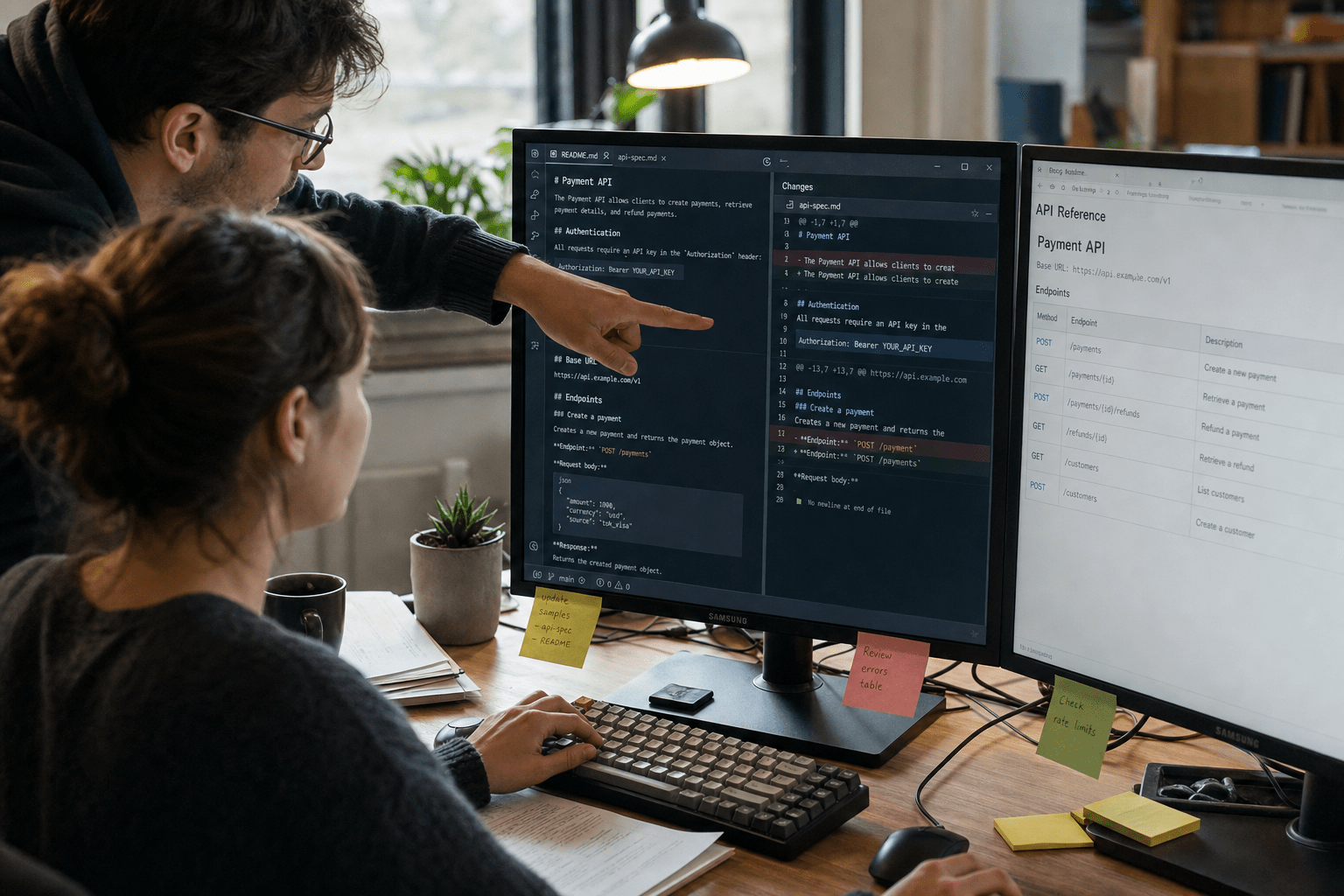
The best AI tools for technical documentation teams in 2026 address four jobs: generating reference material directly from the source of truth, detecting which pages a product change has silently invalidated, enforcing terminology and style at review time, and answering reader questions from the corpus you already have. Drafting new prose is the job these tools are usually bought for, and it is the one documentation teams were already handling. The unsolved problem is knowing what went stale.
Five Points That Decide Whether Documentation Tooling Helps
We build and maintain internal documentation for our own engineering teams and for client platforms, and five points decide how these programs go:
- Staleness is invisible without a change signal. No standard docs pipeline tells you that shipping a renamed field broke four pages. The docs stay green until a reader complains.
- Generated reference beats hand-written reference. Anything derivable from an API definition or a schema should be generated, because hand-maintained copies drift within a release or two.
- Screenshots age fastest and are checked least. A UI refresh invalidates every screenshot at once, and nothing flags them.
- Style enforcement belongs in the review, not the style guide. A guide nobody opens changes nothing. A linter in the pull request changes everything.
- Search quality determines whether documentation gets used. Excellent pages nobody can find have the same practical value as missing pages.
This piece is written for documentation leads, engineering managers, and IT teams at firms of roughly 50 to 500 staff who own internal or customer-facing technical content without a large writing department.
Why Documentation Rots While the Pipeline Reports Success
Documentation decays because the publishing process has no connection to the product changes that make pages wrong. We see this constantly: a docs site builds cleanly, every link resolves, the pipeline is green, and a third of the content describes behavior that changed two releases ago. Nothing in that pipeline is designed to notice.
Nothing connects a code change to the pages it invalidates
The gap is structural. A pull request that renames a configuration key knows nothing about the seven pages mentioning that key by name. Reviewers checking the code have no prompt to consider documentation, and writers reading release notes have to infer impact from summaries that rarely name affected fields.
This is the most valuable place to apply automation, and it is not primarily a language task. Extracting identifiers from a diff and matching them against the docs corpus is largely mechanical, with models useful for the interpretive part: judging whether a mention is describing the changed behavior or merely referencing it in passing. Teams that wire this up get a list of candidate stale pages per release, which converts an unbounded maintenance problem into a review queue.
A counterpoint is worth stating. This produces false positives, and a queue full of pages that turn out to be fine trains writers to ignore it, which is the same failure mode as a noisy alert console. Tuning matters, and the honest starting position is to scope detection to high-traffic pages and to identifiers that appear in code samples, where a stale mention is unambiguously wrong.
Reference documentation is copied instead of generated
Hand-written reference sections are the most reliable source of documentation defects, because they duplicate information that already exists in a machine-readable form. Endpoint parameters, configuration options, error codes, and permission scopes all live in a definition file or a schema somewhere, and a prose copy begins drifting immediately.
Generation from the source removes the drift entirely, and the tooling for this is mature. Where models add something is in the surrounding narrative: generated reference is accurate and unreadable on its own, so the useful pattern is generated tables plus authored explanation of when and why to use each option. Teams that try to author the reference tables by hand are choosing to maintain a copy nobody can keep current.
Screenshots and UI walkthroughs are nobody’s responsibility
Visual content has the worst maintenance profile in documentation. A single interface redesign invalidates every screenshot across the corpus simultaneously, and because images do not break builds, nothing surfaces the problem. Readers notice immediately, which is why stale screenshots do disproportionate damage to trust.
Automated capture addresses this properly. Where screenshots are produced by a script driving the real interface, a UI change means re-running the capture rather than manually re-taking dozens of images. Setting that up is real engineering work and it is the difference between visual documentation that stays current and visual documentation that quietly becomes fiction.
Best AI Tools for Technical Documentation Teams by the Task They Absorb
The tooling divides into generation, maintenance detection, quality enforcement, and retrieval. Most teams over-invest in the first and under-invest in the second, which is the inverse of where the pain sits.
Authoring and drafting assistants
Drafting assistants integrated into documentation platforms and editors produce first drafts from a technical input such as a design document, a changelog entry, or a transcript of an engineer explaining a feature. That last input is underrated: a fifteen-minute recorded conversation with the engineer who built something converts into a solid draft, and it is far easier to get than written notes.
The limitation is that assistants write fluently about things they cannot verify. A generated procedure will confidently describe a menu path that does not exist, and the error is invisible to anyone who has not performed the task. Draft with them, then verify against the actual product, and treat any generated step-by-step procedure as unverified until someone has followed it.
Change detection and coverage analysis
This category is thinner in off-the-shelf products and often assembled from parts, which is why it gets skipped. The pattern is a pipeline step that reads the release diff, extracts changed identifiers, searches the docs corpus, and opens a review task listing candidate affected pages.
Coverage analysis is the complementary half: comparing the product surface, meaning the endpoints, settings, and features that exist, against what the documentation actually covers. That comparison reliably finds features shipped without documentation, which no writer can enumerate from memory. We rate this the highest-return investment for teams whose corpus has grown past a few hundred pages, and it is the one most likely to need building rather than buying.
Style, terminology, and review enforcement
Linting tools such as Vale, extended with model-based checks, enforce terminology consistency, reading level, and structural conventions at review time rather than in a document nobody consults. Enforcement in the pull request is what makes a style guide operative.
The caution here is over-enforcement. A linter tuned aggressively will flag acceptable prose constantly, and contributors respond by disabling it or by writing to satisfy the tool rather than the reader. Our experience is that a small set of firmly enforced rules covering product names, forbidden ambiguous phrasing, and required section structure outperforms a large ruleset applied loosely. Teams standardizing how contributions flow through review may find our notes on choosing collaboration tools relevant to where that review actually happens.
Retrieval and answer generation
Retrieval systems over your documentation corpus answer a reader’s question directly and cite the pages they drew from, which changes documentation from something to be browsed into something to be asked. For internal documentation especially, this raises usage substantially.
Two conditions decide whether it works. The corpus has to be accurate, because a retrieval system over stale documentation produces confidently wrong answers faster than a reader would have found them by browsing, which is worse than no system. And citations must be visible, so a reader can check the source when an answer looks off. Retrieval amplifies whatever quality your corpus has, in both directions, which is another reason to fund staleness detection before answer generation. Teams running documentation inside Microsoft Teams often want the answer surface there, and that integration is straightforward once the corpus is trustworthy.
The Foundations That Make Any of This Work
Three foundations decide whether documentation tooling produces value, and none of them are AI features.
Documentation in version control comes first. Content in a database behind a proprietary editor cannot be diffed, linted, reviewed alongside code, or matched against a release diff. Docs-as-code is the prerequisite for nearly every capability above, and migrating to it is usually the single highest-value project a documentation team can run.
A machine-readable product surface comes second. Coverage analysis and reference generation both need a definition of what exists, whether that is an OpenAPI document, a configuration schema, or a feature registry. Where no such definition exists, creating one benefits engineering as much as documentation.
Ownership per page comes third. Every page needs a named owner who receives its staleness alerts, because a detection system that files findings to nobody produces a growing backlog and no repairs. This is the same principle that makes any operational tooling work, and it is why choosing the right IT tooling matters less than deciding who acts on what it reports.
Sequencing This Without Adding Maintenance Debt
The order that works starts with the boring infrastructure. Move documentation into version control if it is not already, since almost everything else depends on it. Generate reference material from the source next, which removes an entire class of drift permanently. Add change detection third, scoped initially to high-traffic pages so the queue stays credible. Add style linting once contributors are already working in pull requests. Add retrieval last, when the corpus is accurate enough that confident answers are a benefit rather than a liability.
Teams that begin with a drafting assistant produce content faster and accelerate the growth of a corpus they cannot maintain, which makes the underlying problem worse rather than better. That is the outcome we see most often, and it is comfortable because output visibly increases while accuracy quietly declines. Firms auditing which platforms are genuinely earning their keep may find our review of managed IT tooling a useful parallel, along with the comparison approach in Microsoft Teams and its alternatives and the consolidation logic in unifying business communications.
Who Is Behind This Guidance
Mindcore builds and maintains technical documentation for its own platforms and for client systems across New Jersey, Florida, South Carolina, and Louisiana, covering internal runbooks, client-facing procedures, and the operational records that audits depend on. Because our engineers both write the documentation and get called when someone follows a stale procedure during an incident, our recommendations weight accuracy and detection over production volume. A wrong runbook step at two in the morning is a different kind of defect than a thin one.
Matt Rosenthal, Mindcore’s chief executive, keeps the practice focused on documentation as an operational control rather than as a content deliverable, which in practice means owned pages, verified procedures, and a signal when reality changes. That standard is why our documentation projects start with version control and ownership rather than with a writing tool.
Frequently Asked Questions
What are the best AI tools for technical documentation teams to adopt first?
Adopt reference generation from your source definitions first, because it eliminates a whole category of drift permanently rather than managing it. Change detection linking release diffs to affected pages is the strongest second step. Drafting assistants are worth adding later, once you can maintain what you already publish.
Can AI keep our documentation up to date automatically?
Not on its own, and it can tell you reliably where to look. Matching changed identifiers in a release against your corpus produces a candidate list of invalidated pages, which is the signal most teams lack entirely. A person still verifies and rewrites, since confirming what the product now does requires checking the product.
Should we let AI write our API reference?
Generate reference from the API definition rather than having a model write it, because the definition is the source of truth and generation cannot drift from it. Use a model for the surrounding narrative explaining when to use each option and what the common mistakes are. That split gives you accuracy where it is mechanical and judgment where it is needed.
How do we deal with outdated screenshots?
Automate capture by scripting the real interface so a UI change means re-running the script instead of manually retaking images. Where automation is not feasible, record which pages contain screenshots and review them as a batch after any interface release. Stale visuals damage reader trust faster than stale prose.
Is a documentation chatbot worth building?
It is worth building once your corpus is accurate, and it is actively harmful before then, because retrieval over stale content produces confident wrong answers faster than browsing would. Always expose citations so readers can verify. Fund staleness detection first, then answer generation.
Book a Free Strategy Call Before Your Next Documentation Push
Documentation work in 2026 rewards teams that invest in detection and punishes the ones that invest only in production. The order that holds up is consistent: get content into version control, generate whatever can be generated from a source of truth, wire product changes to the pages they invalidate, enforce a small set of style rules in review, and add retrieval once the corpus deserves that much trust. Teams that follow it end up with documentation people rely on during incidents. Teams that lead with a drafting assistant end up with more pages and less confidence in any of them. If you want an outside read on your documentation pipeline, your runbook accuracy, or how to wire change detection into an existing release process, book a free strategy call and our engineers will walk through it with you.

