


Amazon Cloud services provide enterprises with scalable infrastructure, secure storage, and advanced tools, making Amazon Cloud services essential for modern business operations. Many businesses large and small rely on AWS for their smooth operations. But truly, what makes AWS special, and how would it benefit your business? This guide explains everything you need to know.
What is Amazon Cloud Services (AWS)?
Businesses researching what is amazon AWS services should understand that AWS is a cloud computing platform offering scalable infrastructure, storage, and online technology resources. Offered with online servers and storage, software tools, and infrastructure cloud services permit businesses to operate efficiently. The services were launched in 2006 when AWS came into widespread use because of its flexibility, reliability, and cost-effectiveness.
AWS makes it easy to do your computing business without the expense of buying hardware. One example would be the use of online servers like AWS instead of setting up physical servers in your office, which is obviously a money and time saver. This is a huge advantage which is why many businesses enjoy using cloud services such as AWS.
Types of Services Offered by AWS
AWS provides three main cloud service models: Infrastructure as a Service (IaaS), Platform as a Service (PaaS), and Software as a Service (SaaS)
Infrastructure as a Service (IaaS)
AWS infrastructures leave room for cloud services that could allow businesses to hold virtual servers and storage facilities online. Basically, there is no need for physical equipment since IT resources can simply scale online. Flexible options are made available by AWS for businesses that are going to craft scalable infrastructures. These quickly adjust your business whenever demand picks up.
Platform as a Service (PaaS)
AWS loves giving the platform tools to developers. Now your IT team can build, test, and manage apps with no worries about that little detail called infrastructure. It clears up all that IT stuff and lets developers spend all their time improving your product rather than managing a bunch of servers.
Software as a Service (SaaS)
AWS has direct online software solutions that can be used by someone right away. Examples of services here range from email services to office applications to customer management software. SaaS will be the easiest to use since it does not require any installations: just enter, and you’re ready.
Key Features of Amazon Cloud Services
The following features further establish AWS as an integral part of many businesses:
Scalability
One thing you can do with AWS is to scale your resources. If by chance there is rapid growth, AWS can meet the increased demands in real time without a moment’s delay. Thus, it suits those companies that need cloud service infrastructure with reliability and scalability.
Security
Amazon Cloud services ensure top-tier security with encryption, identity management, and compliance-focused controls, demonstrating how Amazon Cloud services safeguard critical business data. It offers state-of-the-art data encryption, secure storage solutions, and powerful backups. With AWS, you can reduce your worries about cyber threats and put more concentration on your business.
Cost-Effectiveness
AWS works on a pay-as-you-go pricing model. You pay only for those services utilized, which is good for the environment for all companies, and thus, cheaper for smaller companies to use the cloud technology.
Global Reach and Reliability
With data centers distributed across the globe, AWS makes sure that your services are available all time. Businesses would enjoy minimum downtime, reduced response times, and dependable performance.
Benefits of Using Amazon Cloud Services for Your Business
Here are a few clear reasons why businesses go with AWS:
Lower IT Costs
Companies gain significant Amazon Cloud services advantages, such as reduced IT costs, by leveraging cloud-based infrastructure instead of physical servers. There is no need for costly physical servers or storage devices. Everything is managed in an online way, considerably decreasing your company IT costs.
Improved Performance
AWS has ensured that your website or applications quickly load. Better performance makes customers very satisfied. Less downtime also occurs and thus the operation of the business remains smooth.
Enhanced Security
AWS keeps all your business data secured. It comprises routine backups, encryption, and strong security measures against protected cyber-attack. Now you can feel relaxed with your data.
Flexibility and Remote Work
AWS provides freedom for employees to work from any point at all. It allows employees to access files, applications, and resources online while enabling effective remote work. That way, you make sure your company producers are active even in casualties.
Easy Disaster Recovery
Even in disasters, AWS maintains your data security. With data stored online securely, this ensures speeding up the process of recovery. This is essential, especially for businesses in places known for calamities weather-related, such as Delray Beach.
AWS vs. Other Cloud Service Providers
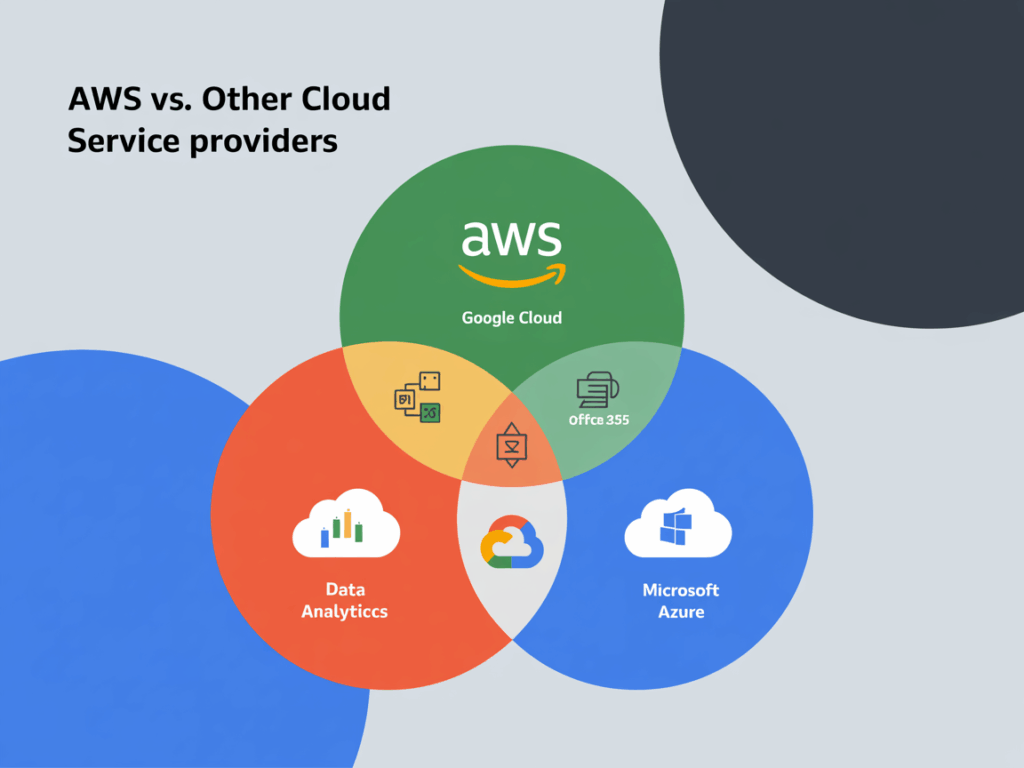
Usually, businesses weigh and evaluate cloud providers to find their best fit. Organizations asking what is amazon AWS services often compare AWS with other major cloud providers like Microsoft Azure and Google Cloud.
Google Cloud is known for excellent analytics and data tools. Microsoft Azure works well with other Microsoft products, including Office 365. AWS is best known for scalability, flexible infrastructure solutions, and a broad global reach.
Keeping your business requirements in perspective while comparing cloud providers is of utmost importance. Each platform has its unique strengths. Choosing the right cloud service provider helps you get the best out of your investment.
Industry-Specific Uses of Amazon Cloud Services
AWS has special benefits for each sector. The gaming industry and the IT industry are two prime examples:
Cloud Gaming Solutions
AWS contributes considerably to gaming performance by lessening delays. Gamers experience seamless gameplay, low-latency, and consistent online experiences. Gaming companies trust AWS because of its strong clouds gaming solutions.
Cloud IT Solutions
AWS is being used for the automation of corporate IT operations. AWS has got automation and easy management tools for the IT department, limiting routine work. Thus IT teams specialize in relevant work since all maintenance is taken care of.
How to Get Started with AWS
Ready to use AWS for your business? Follow these clear steps:
- Evaluate your business needs – Identify your current IT requirements and business goals.
- Choose suitable AWS services – Select services matching your exact needs, such as infrastructure or software solutions.
- Migrate your data safely – Move your data to AWS with minimal downtime and disruption.
Taking these simple steps helps you smoothly transition to cloud technology without impacting daily operations.
Choosing the Right AWS Solutions for Your Business
Choosing the right cloud solution is not a simple endeavor. The first step is to cite the specifications of the business requirement. Thereafter, highlight the areas for improvement, such as reducing costs, increasing security, or scaling infrastructure.
Then, compare the cloud providers thoroughly on all fronts. Now stop thinking about those AWS features; start thinking of your own business goals. The fact that AWS offers a lot of solutions makes it all the more important for you to make a wise choice for your business.
Conclusion
Companies searching what is amazon AWS services often discover that AWS provides powerful cloud tools that support scalability, flexibility, and operational efficiency. Flexibility, security, cost savings, and superior performance are available at AWS. Infrastructure solutions, software tools, and scalable cloud technology, they offer everything.
Integrating AWS into operations has developed businesses and made them competitive. As you dig deeper into exploring what cloud services can offer, you can always check out our well-rounded guide on cloud services for businesses in Delray Beach to fully appreciate the great potential of cloud technology.
Frequently Asked Questions
What is Amazon Web Services (AWS)?
Amazon Web Services (AWS) is a cloud computing platform that provides infrastructure, storage, databases, networking, software tools, and other cloud-based resources over the internet. Businesses use AWS to improve scalability, flexibility, performance, and operational efficiency while reducing dependence on physical servers and on-site infrastructure.
Instead of purchasing and maintaining all computing hardware internally, businesses can use AWS resources online. This allows organizations to access infrastructure and technology services according to their operational requirements while reducing the need for extensive physical equipment.
What are the main benefits of AWS for businesses?
The main benefits of AWS for businesses include lower IT costs, scalable infrastructure, improved performance, stronger security controls, remote access, and easier disaster recovery. Its pay-as-you-go model also helps organizations adjust technology resources based on demand instead of investing heavily in physical infrastructure upfront.
AWS can support organizations that need to increase computing capacity, provide employees with remote access to resources, protect business data, and recover more efficiently after disruptions. Its scalable model also allows technology resources to change as business requirements evolve.
What types of cloud services does AWS provide?
AWS provides Infrastructure as a Service, Platform as a Service, and Software as a Service solutions. These cloud models support virtual servers, storage, application development, software delivery, and other technology needs, allowing businesses to choose services that match their infrastructure, development, and operational requirements.
Infrastructure as a Service supports virtualized computing resources such as servers and storage. Platform as a Service gives developers tools for building and managing applications, while Software as a Service delivers applications through the internet without requiring local installation.
How does AWS improve cybersecurity and data protection?
AWS helps businesses improve security and data protection through encryption, identity management, secure storage, backups, monitoring tools, and compliance-focused controls. These capabilities can help organizations protect sensitive information, manage access, strengthen resilience, and reduce cybersecurity risk across cloud-based systems and business operations.
Security remains a shared operational consideration when businesses adopt cloud infrastructure. Organizations should determine how AWS security capabilities fit their own access requirements, data protection needs, backup processes, and broader cybersecurity strategy.
Is AWS suitable for small and mid-sized businesses?
Yes. AWS is suitable for small and mid-sized businesses because it offers scalable infrastructure, flexible pricing, and access to cloud services without requiring large upfront hardware investments. Businesses can select the services they need, adjust resources as demand changes, and support growth without building extensive on-site infrastructure.
Smaller organizations can use AWS to access cloud infrastructure while avoiding some of the cost and maintenance associated with purchasing additional physical servers and storage. Businesses should still evaluate their technology requirements and choose AWS services that align with their specific goals.
Cloud Infrastructure and AWS Strategy Expertise from Matt Rosenthal
Matt Rosenthal, CEO of Mindcore Technologies, has extensive experience helping organizations modernize operations through secure and scalable cloud infrastructure strategies using platforms like AWS. His expertise in cloud migration, cybersecurity, infrastructure optimization, disaster recovery, and operational resilience helps businesses improve performance, reduce IT overhead, and strengthen long-term scalability. His leadership focuses on designing cloud transformation strategies that align AWS technologies with business growth, operational continuity, security governance, and digital modernization initiatives.

