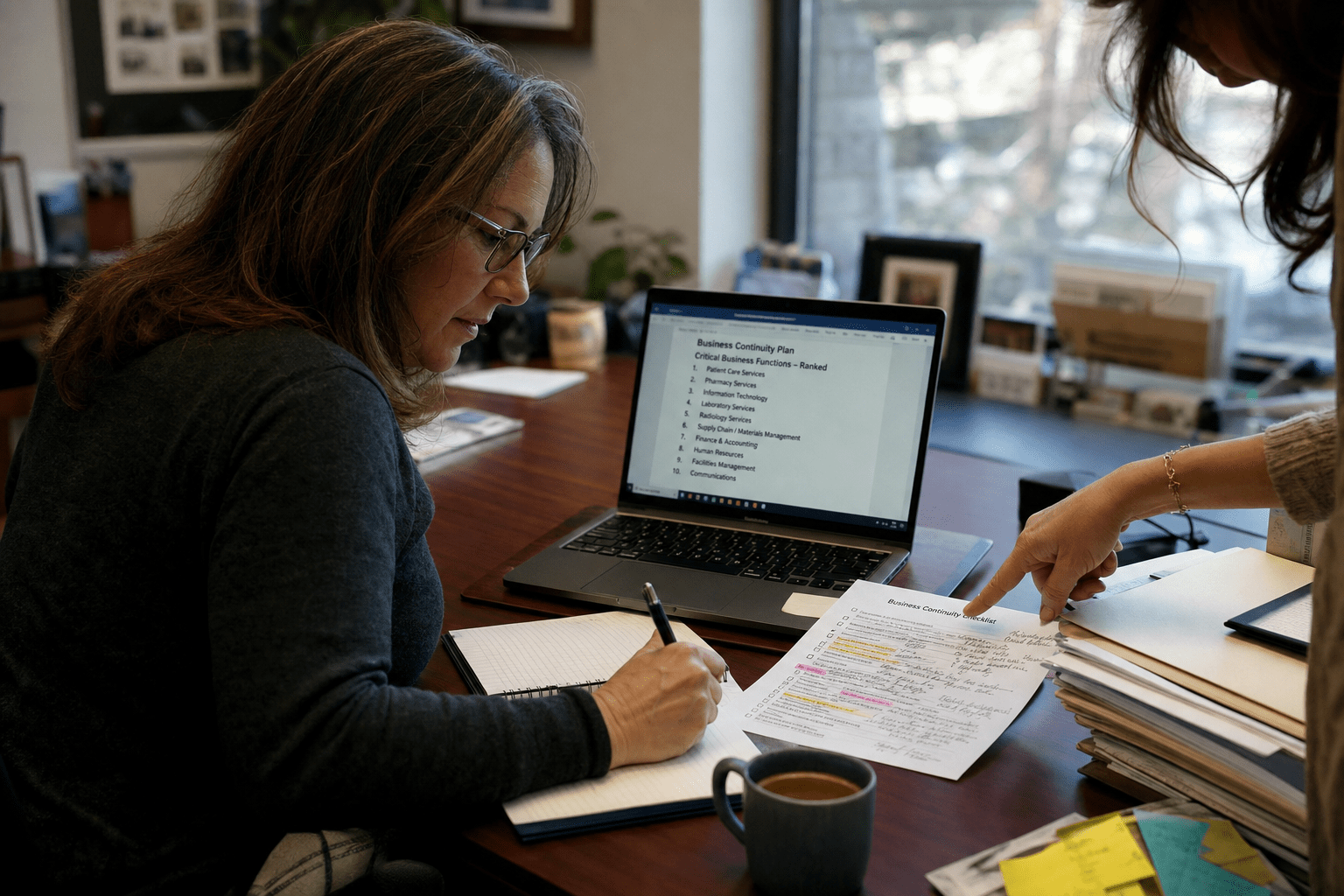
Understanding How to Write a Business Continuity Plan helps you start by identifying the functions your business cannot operate without and rank them according to downtime tolerance before building recovery and communication steps. The plan is not a template you fill in. It is a decision document that records what keeps your company alive during disruption and who does what to keep it that way. We have watched companies download a polished template, populate every field, and still fail their first real test, because they skipped the one step that gives the rest meaning: figuring out, before writing a word, which functions matter most and how fast they have to come back. This guide walks through the build in the order that actually holds up under pressure.
The Five Steps That Make a Plan Work
If you are starting a business continuity plan for a 50 to 500 person company, these are the moves that matter:
- Begin with a business impact analysis, not the document. Rank functions by survival time first.
- Assess the real threats to your business, from cyberattacks to power loss, and weigh each by likelihood and damage.
- Build recovery strategies that meet the survival times your analysis revealed, not the ones your tools default to.
- Write a communication plan that names who decides, who notifies, and how people reach each other when systems are down.
- Test the plan on a schedule and update it after every major change, because an untested plan is an assumption.
Why Most Plans Fail Their First Real Test
Most business continuity plans fail because they were written as paperwork rather than as decisions. A plan built from a generic template looks complete, yet it often records what the template wanted rather than what the business needs. The U.S. Small Business Administration’s guidance on starting a continuity plan stresses understanding your operations before documenting them, because a plan disconnected from how the business actually runs cannot guide anyone in a crisis.
When our team reviews a failed plan, the same pattern shows up. The document lists systems and contacts, but nobody can answer the practical questions: which three functions absolutely cannot stop, who is allowed to declare an incident, and what the manual workaround is for the most critical process. Those answers come from analysis, not formatting. A plan that skips the analysis is a binder, and a binder does not run a company through a flood. Our business continuity planning service starts with that analysis precisely because it is the foundation everything else stands on.
Start With a Business Impact Analysis
A key part of How to Write a Business Continuity Plan is conducting a business impact analysis to rank each business function by downtime tolerance before determining recovery priorities. List your functions: order processing, billing, customer support, production, payroll. For each, ask how many hours or days it can stop before you lose customers, money, or legal standing. Some argue this step is too slow and that companies should just start documenting. There is a grain of truth, since analysis can stall if it chases perfection. The stronger position is that a rough but honest ranking, done in a week, is worth more than a polished document built on guesses. Time-box the analysis, but do not skip it.
Assess Threats by Likelihood and Damage
How to Write a Business Continuity Plan involves performing a threat assessment that identifies potential disruptions and weighs each by likelihood and impact. The continuity planning process frames this well: identify the events most likely to disrupt operations, from natural disasters to cyberattacks to extended power loss, then evaluate each one’s probability and impact. One school of thought says plan for everything equally. Another says plan only for the most likely event. Neither serves you fully. The grounded approach plans hardest for events that are both reasonably likely and seriously damaging, while keeping lighter contingencies for rare but catastrophic ones. A regional power outage and a ransomware hit deserve detailed plans. A meteor strike does not.
Build Recovery Strategies That Meet Your Tolerances
Knowing How to Write a Business Continuity Plan ensures that recovery strategies are tailored to restore critical functions within the tolerances defined by your impact analysis. This is where the plan connects to technology and resources. If order processing must return within four hours, the recovery strategy has to deliver that, whether through failover systems, a secondary site, or a documented manual process. A view that treats recovery as purely an IT task misses the point, because some recovery is manual and human. The complete approach pairs technical restoration with practical workarounds, so a function can limp along by hand while systems come back. Our business continuity and disaster recovery program builds both sides together.

Writing and Maintaining the Plan Itself
Once the analysis, threats, and strategies are settled, you write the plan as a clear action document and keep it alive through testing. The eight elements of a business disaster recovery plan give a useful structure for the document, but the writing is the easy part once the thinking is done.
Write a Communication Plan With Named Roles
A communication plan names who declares an incident, who notifies staff and customers, and how people reach each other when normal channels fail. How to Write a Business Continuity Plan includes crafting a communication plan with named roles that clearly specify who declares incidents, notifies staff and customers, and manages communication when normal channels fail. This section saves companies more often than any technical control, because confusion during the first hour of an outage costs as much as the outage itself. Write down the chain of authority, the contact methods that work when email and phones are down, and the message templates for customers. Assign real names, not job titles alone, and list a backup for each role. A plan that says “IT will notify staff” without saying who and how is not a plan.
Document Manual Workarounds for Critical Functions
Manual workarounds describe how a critical function keeps running for a few hours without its normal systems. If your order system goes down, can staff take orders on paper and enter them later? If the payment system fails, what is the fallback? These workarounds are the bridge between the moment disruption hits and the moment recovery completes. They cost almost nothing to write and pay off enormously when the systems are dark and customers are still calling. This is the part templates almost always omit and the part real plans depend on.
Test the Plan and Keep It Current
A business continuity plan must be tested at least annually and updated after any major change to systems, staff, or facilities, because a stale plan misleads the people relying on it. Run a tabletop exercise where the team walks through a scenario and finds the gaps. Run a live drill on critical recovery paths to prove they hit their targets. Each test reveals something the document got wrong, and fixing those gaps is how a plan earns trust. Treat the plan as a living document that grows with the company, not a file you write once and forget.
Frequently Asked Questions
What is the first step in writing a business continuity plan?
The first step is a business impact analysis that ranks your functions by how long each can stop before serious damage. This ranking tells you where to focus recovery effort and budget. Writing the document before this analysis produces a plan disconnected from what the business actually needs.
How long does it take to write a business continuity plan?
A workable first version takes a few weeks for most small and mid-sized companies, with the impact analysis taking the most time. The goal is a usable plan quickly, then refinement over time. A rough but honest plan in a month beats a perfect one that never gets finished.
Do small businesses really need a business continuity plan?
Yes, small businesses often need a continuity plan more than large ones, because they have fewer resources to absorb a disruption. A single extended outage can end a small company that has no plan to keep serving customers. The plan does not have to be long, but it has to exist and be tested.
How often should a business continuity plan be updated?
A business continuity plan should be updated at least once a year and after any major change to systems, staff, locations, or vendors. Outdated contact lists and retired systems make a plan dangerous, since people follow steps that no longer work. Regular testing surfaces what needs updating.
Talk to a Strategist About Building Your Plan
Writing a business continuity plan from scratch is less about the document and more about the decisions behind it: which functions cannot stop, how fast they must return, who acts when disruption hits, and how the company keeps serving customers in the meantime. Get those decisions right and the writing follows easily. Skip them and the most polished template in the world will fail your first real test. Our team builds these plans with growing companies by starting where it counts, a business impact analysis that ranks your functions by survival time, then turning that ranking into recovery strategies, communication steps, and workarounds that hold up under pressure. If you want help building a plan that works when you need it, book a free strategy call with a Mindcore strategist.
Business Continuity Planning and Operational Resilience Expertise from Matt Rosenthal
Matt Rosenthal, CEO of Mindcore Technologies, has over 30 years of experience helping SMBs build business continuity plans that function under real disruption rather than sitting in a binder that fails its first live test. He has seen firsthand how companies that populate a polished template without completing a business impact analysis produce a document that cannot answer the three questions that matter most: which functions cannot stop, who declares an incident, and what the manual workaround is when systems are dark. Matt leads a team that starts every continuity engagement with a ranked impact analysis, then builds recovery strategies, communication chains, and manual workarounds that match the survival tolerances the business actually has.