

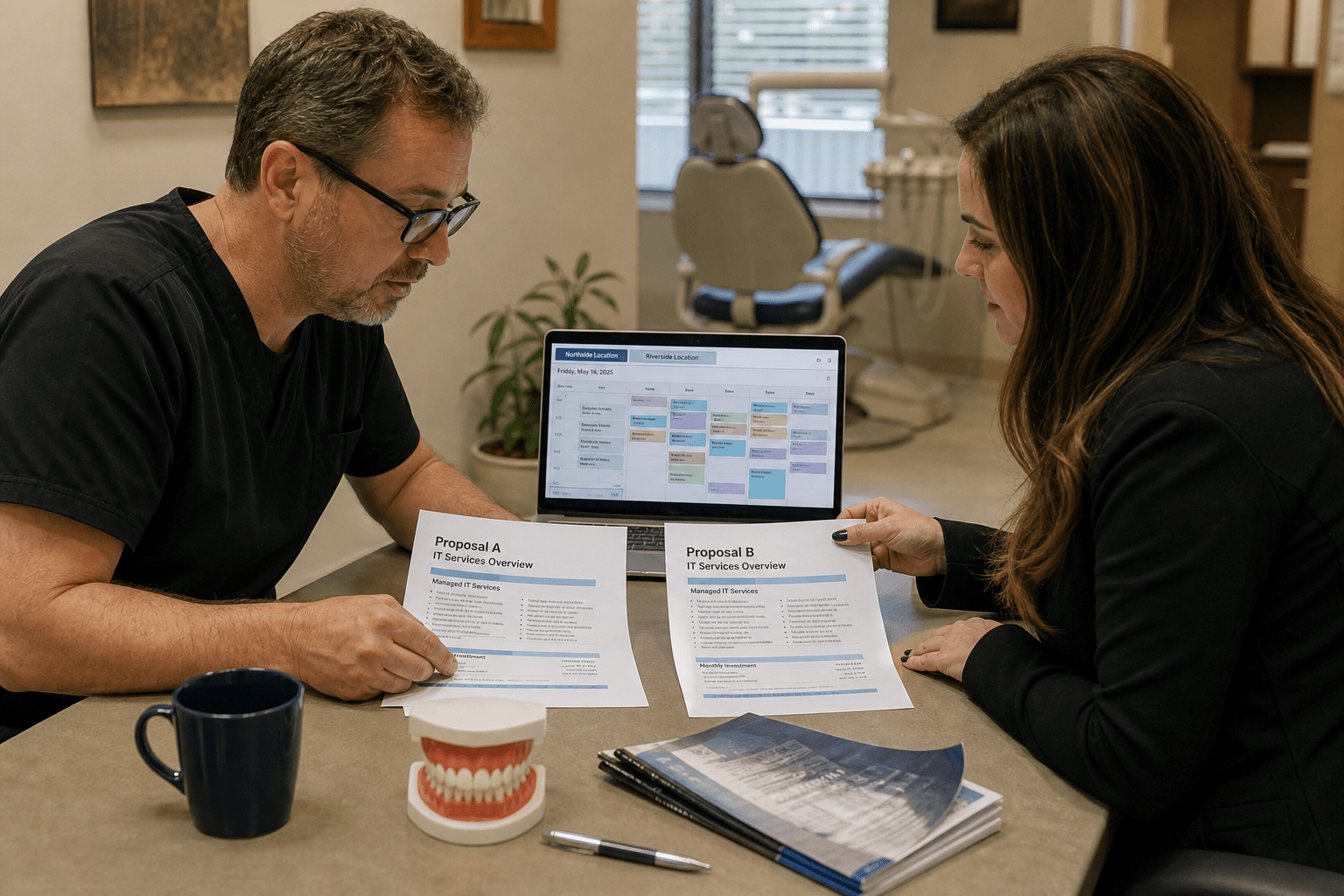
Choosing between in-house IT and outsourced managed IT for dental practices is usually framed as a hiring decision, and that framing hides the real constraint. Most practices are too small to keep one person busy full time and too dependent on imaging to accept a slow response. So the question is not whether to hire, it is who reaches the operatory within the hour when a sensor stops responding, and who answers when that happens at two locations on the same morning. The answer for most groups combines an internal owner with outside depth.
Five Points This Comparison Rests On
Practices tend to compare a salary against a monthly fee and stop there, which leaves out everything that decides the outcome. The points below are what genuinely differs. This is written for practice owners and office managers running one to six locations, typically 4 to 20 operatories in total.
- A single-location practice rarely fills a full-time role. The work is real but intermittent, and an underused hire drifts into duties that were never the point.
- Imaging support is specialist work. Sensor drivers, imaging bridges, and vendor certification are a narrow field that a generalist learns slowly.
- Multiple locations break the internal model first. One person cannot be at two practices at once, and travel between them consumes the day.
- Chair time sets the response clock. A response measured in hours is a schedule measured in lost appointments, whichever model provides it.
- Turnover cuts both ways. Dental teams change often, and so do small IT providers, so continuity has to be designed rather than hoped for.
Where an Internal Hire Helps a Dental Practice
An internal hire helps most with immediacy and with knowing the practice’s own quirks, which in a dental setting means knowing which room has the temperamental sensor and which workflow the hygienists actually use. Our team has worked alongside internal staff and replaced them, and these strengths hold up.
Someone Is Already in the Building
A person on site can restart an imaging workstation between patients rather than opening a ticket. In a practice where the schedule is booked to the quarter hour, that immediacy is worth more than it looks on paper.
The counterpoint is that a single-location practice cannot keep that person occupied. What usually happens is the role expands into equipment ordering, vendor calls, and general office duties, and the technical work becomes a part-time function performed by someone whose title says otherwise.
The honest read is that presence is valuable and full-time presence is often more capacity than a single practice needs. Where we see this work is a part-time internal owner handling daily friction with managed IT services carrying the depth behind them.
Knowledge of the Practice’s Own Setup
Every dental practice accumulates specifics: an imaging bridge configured a particular way, a workaround for the older operatory, a printer that only works from one station. An internal person learns these and stops rediscovering them.
Against that, this knowledge is almost always undocumented, and dental practices are unusually exposed to it because so much of the setup was configured by a vendor years ago. When the person who knew leaves, the practice is back to guessing.
Our position is that practice-specific knowledge is genuinely useful and only survives if writing it down is part of the job. Practices deciding what belongs inside may find our piece on what to look for in managed IT services for dental practices a useful split of duties.
Direct Control Over What Gets Attention
An owner can tell an employee to drop everything and look at the sensor in room three. That is simple, immediate, and satisfying in a way a support agreement is not.
The fair response is that this is also why nothing planned gets finished. Backup verification, access cleanup, and the storage review all lose to whatever is urgent, and in a practice with one technical person they lose every week.
Both hold, which is why separating priority control from delivery capacity works better than choosing one model outright. That separation is the shape a co-managed arrangement takes.
Where Outsourced Managed IT Wins for a Dental Practice
Outsourced managed IT wins on specialist depth, multi-location coverage, and continuity of the recurring work, because each of those depends on more than one person and on repeated exposure to the same problems across practices.
Imaging and Practice Management Vendors Are a Narrow Specialty
Imaging bridges, sensor drivers, and practice management databases behave in particular ways, and knowing them comes from seeing many practices rather than one. A provider working across dental clients accumulates that pattern library. An internal hire at one practice does not.
Some owners respond, fairly, that their internal person eventually learns their own systems thoroughly, and that is true. Depth on one environment is real expertise.
What one environment cannot teach is what a problem looks like when it is the vendor’s fault rather than yours, which is the judgment that shortens an outage. That comparison across practices is also what makes managed security services useful rather than generic, since the same attack patterns recur across similar practices.
A Second Location Breaks the Internal Model
The moment a practice opens a second site, one person is either driving or unavailable. Travel time is real, and a sensor problem at the far location during a full schedule is exactly when nobody wants to hear about a thirty-minute drive.
There is an argument that remote tools solve this, and they solve a good part of it. Many issues genuinely do not need hands on site.
Imaging problems frequently do, though, and so does anything involving a physical device or a network port. Multi-location groups tend to reach the same conclusion: keep an internal person for the practice relationships, and use a provider with enough people to send one when hands are needed. Groups tracking whether that is actually happening can use the framework in our piece on measuring a managed IT partnership.
The Recurring Work Actually Gets Done
Backup verification, restore testing, access reviews after staff changes, patch status, and storage growth checks are monthly obligations. In an internal model they are the first things postponed, because nobody in the practice is asking for them today.
A reasonable objection is that a disciplined internal hire keeps up with these perfectly well, and some do. The difficulty is that the discipline is personal rather than structural, so it leaves when they do.
What we recommend either way is that these tasks appear in writing with a cadence and a record, so a practice can see whether they happened rather than assuming. Practices carrying protected health information have the same obligation regardless of model, which our overview of HIPAA compliant IT services sets out in more detail.
The Cost Comparison for a Practice This Size
A fair comparison counts the same things on both sides. For an internal hire, count salary, payroll taxes, benefits, recruiting, training, the monitoring and backup tools they will need, and the weeks nobody covers. For a provider, count the monthly fee, out-of-scope work, onboarding, and the office manager’s time spent managing the relationship.
For a single-location dental practice the arithmetic usually favors a provider outright, because a full-time salary buys more hours than the practice can use while leaving the specialist gaps unfilled. The comparison tightens at three or more locations, where a full-time internal role becomes genuinely busy and the case for an internal owner plus outside depth gets stronger. Practices deciding where they sit on that curve should count locations and operatories before counting dollars.
Continuity Has to Be Designed in Either Model
Dental teams turn over frequently, and so do the small providers that serve them. A practice that assumes stability from either model is planning on something neither reliably supplies.
For an internal hire, continuity means documentation as a job expectation with a defined format, plus a standing relationship with an outside party who could step in during an absence. For a provider, it means a named primary contact, a named backup, and documentation held where the practice can read it without asking.
Some owners argue that a long-tenured provider makes this ceremony unnecessary, and long tenure genuinely does reduce the risk. It does not remove it, because the technician who knows your imaging bridge can leave the provider without the practice ever hearing about it. What protects a practice is written detail rather than trust in a relationship, and the request costs nothing to make during selection.
How Practices Usually Decide
Practices decide this well by counting the hours they are exposed and naming what only one person can do, because both are concrete and neither requires trusting a sales pitch.
Count Chairs, Locations, and Open Hours
Write down the number of operatories, the locations, and the hours patients are in the chair across all sites. That total is the exposure. Compare it to one person’s realistic 36 to 40 hours.
Single-location practices usually find that a full-time hire is more capacity than they need in hours and less than they need in specialties, which is a useful thing to see written down. Multi-location groups usually find the opposite: once three sites are open, the travel alone fills a role, and the internal person becomes valuable precisely because they know which site has which quirk. The crossover point is not a rule, and the count tends to make it obvious for any given practice. Owners who do this exercise once rarely need to repeat it, because the answer changes only when a location opens or closes.
Ask What Happens on a Busy Tuesday at Two Sites
Put the scenario to any candidate provider, and honestly to your internal plan: imaging is down at one location, the practice management system is slow at the other, and both are fully booked. Ask who goes where, in what order, and how long until someone arrives.
You are listening for names, a sequence, and a travel time. Ask also what they would have done the day before to make that Tuesday less painful, because the answer separates a provider who reacts from one who prevents. Practices that ask this question of two or three candidates find the answers differ far more than the proposals do, and the difference predicts the working relationship better than price. A provider who answers with a ticket process is describing a queue. A provider running managed firewall services and network support across your sites should also be able to say which problems they can resolve without driving at all, which is often more than owners expect. The same clustering of failures affects medical clinics, as our piece on why healthcare practices need managed IT services describes from that side.
Frequently Asked Questions
Should a single-location dental practice hire IT staff?
Usually not as a full-time role, because the work is intermittent while the specialist needs are real. Most single-location practices are better served by a provider, sometimes paired with a part-time internal owner who handles daily friction.
At what point does an internal hire make sense for a dental group?
Commonly around three or more locations, where travel, vendor coordination, and staff turnover generate enough steady work to fill the role. Even then, most groups keep outside depth for imaging specialists and after-hours coverage.
Who should handle the practice management vendor relationship?
Either party can hold the relationship, and the agreement should still name who owns an incident through restoration regardless of fault. Practices that keep the relationship internally and assign escalation ownership to the provider tend to get the best of both.
How is imaging support different from general IT support?
It involves sensor drivers, imaging bridges, and vendor certification requirements that behave differently from ordinary workstation software. Experience across multiple dental practices shortens these problems considerably.
What recurring tasks should be in writing whichever model we choose?
Backup verification with a quarterly restore test on imaging, access review after every staff change, patch status by device, and a storage growth check. Each needs a cadence and a written record so the practice can confirm it happened.
Who Is Behind This Advice
Our team spends its time in practices where the schedule decides everything, and that shapes how we read this comparison. The practices that are happiest with their arrangement are rarely the ones that found the cheapest option. They are the ones that counted their chairs and locations honestly, listed what only one person could do, and then chose. That exercise takes an afternoon, and it is a far better basis than a referral or a quote.
Mindcore is led by Matt Rosenthal, who focuses on making coverage and security commitments measurable for smaller practices, so an owner can compare options without a technical background.
Talk Through the Comparison for Your Practice
Two counts make this decision much clearer: the hours across all your locations when patients are in the chair, and the list of tasks that depend on one person or one vendor. Cost belongs in the analysis and rarely settles it, particularly for single-location practices where a full-time hire buys hours the practice cannot use.
If you would like help running the comparison, we are glad to do it with you. Bring whatever arrangement you have today, your operatory count and hours across sites, your imaging and practice management vendors, and any task that has been waiting more than six months. We will lay out what each model would look like for your practice, including the co-managed middle, and we will say plainly if what you have now is already the right fit. You can book a free strategy call and we will work through it together.

