

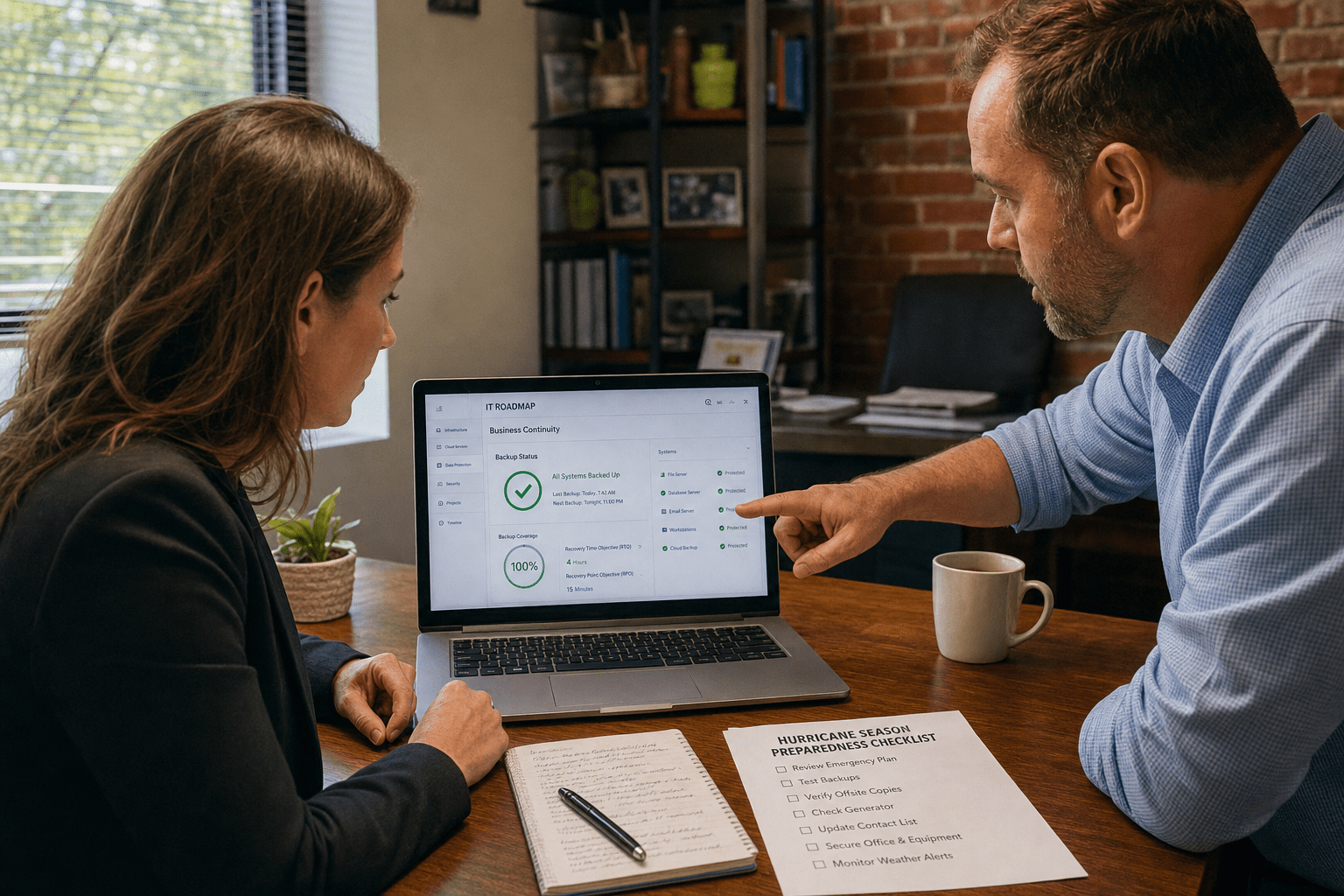
IT consulting in Louisiana means choosing a technology partner who plans for the state’s real conditions: a hurricane season that can take an office offline for days, a growing set of data-protection obligations, and a business climate where New Orleans, Baton Rouge, and Lafayette firms compete for the same talent. A good consultant does more than fix computers. They set a technology roadmap, harden your business against the storms and cyberattacks that hit hardest here, and make sure a lost building never means a lost company. The first test for IT Consulting Louisiana is whether the provider can keep your business operating when both the office and power are unavailable.
The 5 Points Every Louisiana SMB Should Weigh
Choosing IT Consulting Louisiana becomes easier when you understand what separates a strategic technology partner from a basic repair vendor. These five points shape the decision for most Louisiana businesses.
- Continuity is not optional here. Any consultant who treats hurricane and flood recovery as an upsell has the priorities backward for this state.
- Local presence still matters. Remote support handles most tickets, but storm recovery and cabling need people who can reach your site.
- Strategy should come before hardware. The firms that spend the least plan a year ahead instead of reacting when a server fails.
- Security follows the money. Attackers target Louisiana SMBs through email and payment fraud, not just headline ransomware.
- The right size beats the biggest name. A partner who fits a 20-person firm looks different from one built for a 500-seat enterprise.
Why Louisiana Businesses Need More Than Break-Fix Support
IT consulting in Louisiana has to account for weather risk that most national providers treat as a footnote, and that single fact reshapes what good support looks like. A break-fix vendor answers when something breaks, which works fine in a calm year. The problem is that Louisiana does not reliably get calm years. When a storm floods a parish or knocks out power for a week, a reactive vendor has nothing prepared, and the businesses that survive are the ones whose data and systems were already running somewhere safe.
The honest counterpoint is that not every Louisiana firm faces the same exposure. A shop in a low-lying coastal area carries very different risk than an office on higher ground in north Louisiana, and a consultant should scope continuity to your actual location rather than sell everyone the maximum plan. Our team maps that exposure first, using the federal Ready.gov business continuity guidance as a baseline and then adjusting for your building, your industry, and your tolerance for downtime. The result is a plan sized to your risk, not a template.
Effective IT Consulting Louisiana prioritizes hurricane preparation, tested recovery, and continuity planning before storm season begins. Our IT consulting practice treats continuity as the foundation for Louisiana clients, because everything else you build on technology assumes the technology is still there after a bad week.
How Storm and Flood Recovery Should Be Planned
Storm and flood recovery works best when your critical data and applications already live in a protected offsite or cloud environment before the season starts, so recovery is a switch rather than a rebuild. The reassuring view is that modern cloud backup makes this affordable even for small firms, and for many businesses a well-configured cloud copy is enough. The harder truth is that a backup nobody has tested is a guess, and plenty of firms discover during an actual storm that their restore takes days they do not have.
We plan recovery around two numbers that any owner can understand: how much data you can afford to lose, and how fast you must be back. Those targets drive everything else, from how often backups run to whether you need a standby environment ready to take over. Then we test the restore on a normal day, because the middle of a hurricane is the worst possible time to learn your plan does not work.
How Local Presence and Remote Support Work Together
Local presence and remote support complement each other, with most daily issues handled remotely and the physical work reserved for what genuinely needs hands on site. One camp argues that in 2026 nearly everything can be done remotely, and they are largely right for software, accounts, and monitoring. The opposing view is that cabling, hardware replacement, and post-storm recovery still require someone who can drive to your building, and that is equally true.
The strongest IT Consulting Louisiana model combines fast remote support with local technicians who can handle hardware, cabling, and post-storm recovery. Day-to-day tickets resolve fast over remote tools, which keeps costs down and response quick. When a storm passes or a network switch dies, a partner with reach into New Orleans, Baton Rouge, and the surrounding parishes can be on site rather than promising a technician next week. Ask any consultant plainly how they handle the work that cannot be done from a keyboard.
How to Match a Consultant to Your Company Size
Matching a consultant to your company size means finding a partner whose typical client looks like you, because a firm built for enterprises tends to over-engineer a small business. A large national provider brings depth, and for a mid-market company that depth is worth paying for. For a 15-person accounting office, that same provider often delivers a process too heavy for the need and a bill to match.
We size the engagement to the business. A small firm usually needs a clear roadmap, dependable support, and continuity it can afford, not a data-center-grade design. A growing firm needs a partner who can scale with it as headcount and compliance demands rise. The Louisiana service area we cover spans both, and the first step is always understanding where your business actually sits before quoting anything.
Where Cybersecurity Fits for Louisiana SMBs
Cybersecurity for Louisiana SMBs protects the money and data that attackers pursue, and it belongs in the consulting plan from day one rather than as a later purchase. Small businesses often assume they are too minor to target, but attackers automate their attacks and hit whoever is exposed. Email fraud is the most common route we see: a criminal watches correspondence, learns a payment routine, then requests a bank-detail change at exactly the wrong moment. The federal Cybersecurity and Infrastructure Security Agency also warns that ransomware can halt an operation by locking the files it runs on.
The defenses are practical and affordable. Multi-factor logins on email and financial systems, a verbal callback rule before any payment change, current backups, and staff who can spot a phishing message stop the majority of what reaches Louisiana SMBs. A consultant should build these in as standard, then layer more protection where your industry demands it. Security and continuity reinforce each other here, since a tested backup is also your best answer to ransomware.
How a Roadmap Saves Louisiana Firms Money
IT Consulting Louisiana helps firms reduce unexpected costs by turning emergency technology spending into a planned, prioritized roadmap. Reactive firms replace equipment when it fails, pay rush rates, and absorb the downtime that comes with a surprise. Firms with a roadmap know when devices age out, when software renews, and how the next hire changes the setup.
A virtual CIO makes this realistic for companies too small for a full-time technology executive. This person owns the plan, aligns spending to your growth, and keeps security and continuity on the agenda before they become crises. Our virtual CIO consulting gives Louisiana SMBs that leadership without a senior salary, and the output is a plain budget you can defend: what you will spend, when, and why.
Frequently Asked Questions
What does IT consulting in Louisiana usually include?
IT consulting in Louisiana usually covers technology strategy, business continuity and storm recovery planning, cybersecurity, cloud setup, and ongoing support sized to your business. Continuity tends to carry more weight here than in lower-risk states because of hurricane and flood exposure. A good engagement starts by mapping your specific location and risk before recommending anything.
Do I need a local Louisiana provider or can I use a national one?
You can work with either, but Louisiana firms benefit from a partner who can reach the site for storm recovery, cabling, and hardware work that cannot be done remotely. National providers bring depth for larger companies, while a partner with regional reach handles the physical work faster. The practical answer for most SMBs blends remote support with real local presence.
How much does IT consulting cost for a small Louisiana business?
Cost depends on company size, your risk exposure, and whether you need ongoing support or a one-time roadmap, so an honest range starts with a conversation. Firms that plan ahead almost always spend less than firms that only call during emergencies. A free strategy call is the fastest way to get a realistic figure for your situation.
How should a Louisiana business prepare its IT for hurricane season?
A Louisiana business prepares by getting critical data and applications into a protected offsite or cloud environment before the season, then testing the restore on a normal day. Two numbers drive the plan: how much data you can afford to lose and how quickly you must be back. Preparing early turns a storm from a company-ending event into a manageable interruption.
Is my small business really a target for cyberattacks?
Yes, because attackers automate their attacks and hit whoever is exposed rather than choosing victims by size. Email and payment fraud in particular target routine business habits, not big names. Basic protections such as multi-factor logins, a payment callback rule, and tested backups stop most of what reaches small firms.
Choose an IT Partner Built for Louisiana
IT consulting in Louisiana comes down to a partner who plans for storms before they arrive, protects your money and data as a default, and sizes the whole approach to your business rather than a national template. That is what keeps a Louisiana SMB running through the weeks that would sink an unprepared competitor. Our team builds these plans by starting with your location, your risk, and your growth, so the recommendations fit the state you actually operate in. If you want to see what a Louisiana-ready technology plan looks like for your firm, book a free strategy call and we will map it with you.

