


When an organization is evaluating whether to stay with a one-person IT vendor or move to a managed IT services provider, the conversation almost always starts with price. That is the wrong starting point.
A monthly invoice is not a scope of work. Two contracts with similar dollar amounts can deliver fundamentally different levels of coverage, accountability, security depth, and organizational risk. Before any price comparison makes sense, you need to understand what each model actually includes and what happens when something goes wrong.
Attackers do not schedule around your vendor’s vacation. Security incidents do not wait until Monday morning. And when the single person who knows your entire IT environment becomes unavailable, the question is not how much you were paying. It is who picks up the phone.
Overview
The choice between a one-person IT shop and a structured managed services provider is a risk decision as much as a cost decision. Both models deliver day-to-day IT support. They differ substantially in what happens when demand spikes, when a security incident occurs, when the individual is unavailable, and when the board asks what IT is actually doing and whether the organization is protected. Understanding those differences is what makes the comparison meaningful.
- Coverage continuity: a one-person shop creates a single point of failure; a MSP provides a team with redundancy.
- Security depth: solo operators rarely maintain dedicated security capability; a MSP operates a siloed security function.
- Accountability: informal arrangements produce no verifiable record of what was done or billed.
- Conflict of interest: structural conflicts require structural resolution, not price negotiation.
- Governance: board-ready reporting requires organizational infrastructure that a solo operator typically cannot provide.
The 5 Why’s
Why is a solo IT vendor structurally unable to provide 24/7 coverage regardless of competence? One person cannot be available around the clock, manage a vacation or illness, and simultaneously respond to an active security incident and routine support tickets. That is a structural limitation, not a performance issue. Managed services providers maintain staffed dispatchers, tiered engineering teams, and on-call coverage that is not dependent on any single individual’s availability.
Why does the absence of documented billing and activity records create organizational risk beyond just inconvenience? If an organization cannot verify what hours were billed or what work was performed, it cannot hold its IT vendor accountable, cannot make informed decisions about where IT investment is going, and cannot demonstrate IT governance oversight to a board, insurer, or regulator. Undocumented IT activity is unauditable IT activity, which is a governance and compliance exposure.
Why is cybersecurity depth specifically unachievable through a one-person IT operation? Enterprise-grade security requires concurrent capability: 24/7 security operations monitoring, incident response, penetration testing, security awareness training management, and strategic security leadership. These functions require dedicated, specialized staff. A solo IT operator who also handles helpdesk tickets, network administration, and vendor management cannot simultaneously operate a security operations center. The functions compete for the same hours. Review the complete guide to managed cybersecurity services for a detailed look at what enterprise-grade security coverage actually requires.
Why does a structural conflict of interest specifically require a structural resolution? A vendor with a financial or ownership interest in the organization they serve cannot provide fully independent advice. Their recommendations may be influenced by interests beyond the client’s best outcome. That conflict does not resolve through better communication, price concessions, or performance improvement. It resolves when the conflicted party is replaced by an independent one. Identifying the conflict and acting on it are separate decisions; conflating them delays a necessary change.
Why does board-level IT governance reporting require organizational infrastructure that solo operators typically cannot provide? Boards overseeing organizations with significant IT risk exposure need regular, structured reporting: monthly activity summaries, quarterly security assessments, and annual risk reviews in formats they can evaluate and record in governance minutes. Producing that reporting requires documentation systems, reporting templates, and the organizational capacity to maintain them consistently, all infrastructure that a solo IT operator rarely builds for a single client relationship. Review the top cybersecurity questions corporate boards should be asking to understand what governance reporting your board needs and whether your current IT arrangement can produce it.
What the Comparison Actually Looks Like
Coverage When Something Goes Wrong
One-person IT shop: when the individual is sick, traveling, on another call, or simply unavailable, there is no coverage. Incidents wait. Projects stall. The organization’s IT resilience is bounded by one person’s schedule.
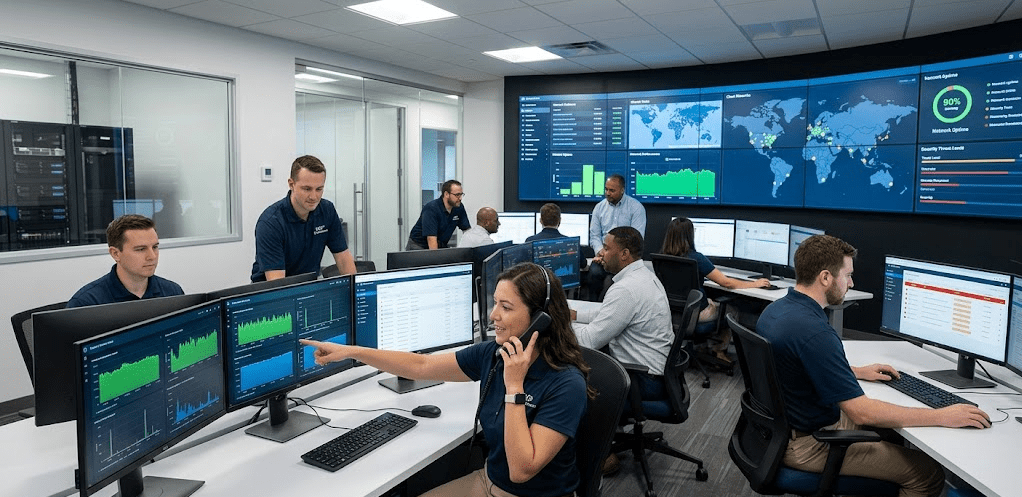
Managed IT services: a staffed dispatcher, tiered L1/L2/L3 engineering team, and defined on-call coverage ensure that a request does not go unanswered because one person is unavailable. The team is the coverage, not the individual.
Response Time Accountability
One-person IT shop: response time depends on when the individual is available. Without a written Service Level Agreement, there is no contractual commitment to a response or resolution window and no accountability mechanism when those windows are missed.
Managed IT services: written SLAs define response time commitments by incident severity. Those commitments are contractual, not dependent on the vendor’s goodwill or current workload.
Security Capability
One-person IT shop: basic endpoint protection at best. No dedicated security team, no 24/7 security monitoring, no incident response capability, no CISO-level security strategy. Security is addressed reactively when issues surface, not monitored proactively before they escalate.
Managed IT services (Mindcore): an in-house CISO, a siloed six-person cybersecurity team dedicated exclusively to security functions, 24/7 Security Operations Center monitoring, and daily penetration testing. Security is not an add-on to break-fix support. It is a separate, parallel function with dedicated staffing. Learn more about Mindcore’s managed security services and how the siloed security function is structured to operate independently from day-to-day IT support.
Billing Transparency
One-person IT shop: hours tracked informally, if at all. The organization typically cannot verify what was billed, what was accomplished, or how time was allocated across support categories.
Managed IT services: full ticket tracking, time logging per incident, and monthly activity reports. Every hour is documented against a specific ticket, enabling the organization to verify exactly what it received for what it paid.
Organizational Risk at Departure
One-person IT shop: when a solo IT operator leaves, voluntarily or otherwise, they take institutional knowledge with them. Network configurations, vendor relationships, credentials, and undocumented processes may not be recoverable without significant effort and cost.
Managed IT services: documentation is maintained from day one as an organizational asset, not an individual’s memory. Transition, if it ever occurs, does not result in knowledge loss.
The Conflict of Interest Problem
One concern that surfaces in some IT vendor relationships is a structural conflict of interest: when the IT vendor has a financial or ownership relationship with the client organization beyond the service contract itself.
No pricing adjustment resolves this. No performance improvement neutralizes it. The conflict exists at the structural level. The vendor’s interests are not fully aligned with the client’s, and the only resolution is a vendor relationship that is structurally independent.
An independent managed services provider has one interest: delivering the service the contract defines, to the standard the SLA requires, for the organization that is paying for it. That alignment is what makes accountability possible. Review how to identify and transition away from an underperforming IT provider for a practical guide to managing that change when the decision has been made.
What Changes With a Managed Services Provider
You stop managing an individual and start managing a contract. A written SLA with defined response tiers, documented deliverables, and accountability mechanisms replaces an informal arrangement that depends on a single person’s availability, goodwill, and capacity.
Your board gets what it needs. Monthly activity reports, quarterly security summaries, and annual assessments in formats designed for governance review, not informal updates delivered when the vendor has time to produce them.
Pricing is flat, predictable, and fully disclosed. Mindcore’s pricing: Mindcore Secure at $75 per workstation per month; Mindcore Complete at $125 per workstation per month. Microsoft 365 licensing passed through at MSRP with no markup. No surprise invoices.
Security is a dedicated function, not an add-on. A six-person siloed cybersecurity team, 24/7 SOC monitoring, CISO leadership, and daily penetration testing, operating independently from break-fix support and not competing with it for the same staff hours.
Continuity is built in. Fully maintained documentation, team-based institutional knowledge, and no single-point-of-failure risk if any individual on the Mindcore team changes roles.
A Simple Risk Check
Ask these questions about your current IT arrangement:
- If your IT vendor is unreachable tomorrow morning at 7 AM, who responds to an active incident?
- Can you verify what hours were billed last month and what work those hours produced?
- Who is monitoring your network for threats right now, at this moment?
- If your IT vendor left today, what organizational knowledge leaves with them?
- Does your board receive structured IT and security reporting on a defined cadence?
If the honest answers to those questions are uncomfortable, the conversation is not about price. It is about what the current arrangement is actually delivering and what the organization’s exposure is if it continues. A structured IT risk assessment gives organizations an objective baseline for answering those questions rather than relying on the vendor’s self-reporting.
Final Takeaway
A one-person IT shop may cost less on paper. It also provides less coverage, less accountability, less security depth, and no redundancy. When evaluated against a managed services provider with a defined team, written SLAs, dedicated security capability, and board-ready reporting, the comparison is not about the invoice. It is about what that invoice actually buys, who is accountable for delivering it, and what the organization’s exposure is if the current arrangement fails.
The right question is not “which costs less?” It is “what is the cost to the organization if the current arrangement is insufficient, and who owns that outcome?”
Review the benefits of managed IT services for growing companies for a broader look at what organizations gain when they move from an informal IT arrangement to a structured managed services engagement.
Meet the Expert Behind Mindcore Technologies
Matt Rosenthal, President and CEO, Mindcore Technologies
Matt Rosenthal has spent more than 30 years at the intersection of enterprise technology and business strategy. As President and CEO of Mindcore Technologies, Matt has guided hundreds of organizations through complex IT challenges, from infrastructure modernization and cybersecurity programs to cloud migration and AI-driven transformation.
His approach is grounded in a straightforward conviction: IT partnerships should be built on accountability, documentation, and measurable outcomes. Not on informal arrangements that leave organizations exposed when something goes wrong. Under Matt’s leadership, Mindcore has earned recognition as a Global Top 250 MSSP and built one of the most comprehensive compliance and security frameworks in the managed services industry.
Frequently Asked Questions
What is the difference between a one-person IT shop and a managed IT services provider?
A one-person IT shop is a single individual handling all IT functions: support, security, projects, and administration. A managed IT services provider is a structured organization with tiered engineering teams, dedicated security staff, defined SLAs, and built-in redundancy. The difference is coverage, accountability, and what happens when the individual is unavailable or something goes wrong. Review what managed IT services actually includes to understand the full scope of what a structured provider delivers.
How does Mindcore handle IT support when someone on the team is unavailable?
Mindcore operates with a full team structure including a dispatcher, L1/L2/L3 engineering tiers, and on-call coverage. No single individual’s availability determines whether a request is answered. Support continuity is a contractual commitment, not a best effort.
What cybersecurity capabilities does Mindcore provide that a solo IT operator typically cannot?
Mindcore maintains an in-house CISO, a six-person siloed cybersecurity team that operates independently from break-fix support, 24/7 Security Operations Center monitoring, and daily penetration testing. These are dedicated functions that a solo operator cannot staff simultaneously with general IT support responsibilities. Review the managed detection and response guide for a detailed look at what continuous security monitoring delivers that reactive break-fix support cannot.
How does Mindcore provide billing and activity transparency?
Every support interaction is logged as a tracked ticket with time documentation and activity detail. Clients receive monthly activity reports that account for every hour billed. There is no informal hour tracking or ambiguity about what was done or when.
What happens to institutional IT knowledge if Mindcore or the client ends the engagement?
Mindcore maintains full environment documentation from day one as an organizational asset. Network configurations, vendor contacts, system credentials, and IT procedures are documented in client-owned records. If the engagement ends, that documentation transfers with the client. No institutional knowledge walks out the door.
See What a Structured IT Partnership Actually Looks Like
Mindcore Technologies provides managed IT services with defined SLAs, a dedicated cybersecurity team, full billing transparency, and governance reporting built for accountability, not for one person’s schedule.
Talk to Mindcore Technologies about managed IT services. Contact Matt Rosenthal and our team to discuss your current IT arrangement and what a structured managed services engagement would look like for your organization.

