

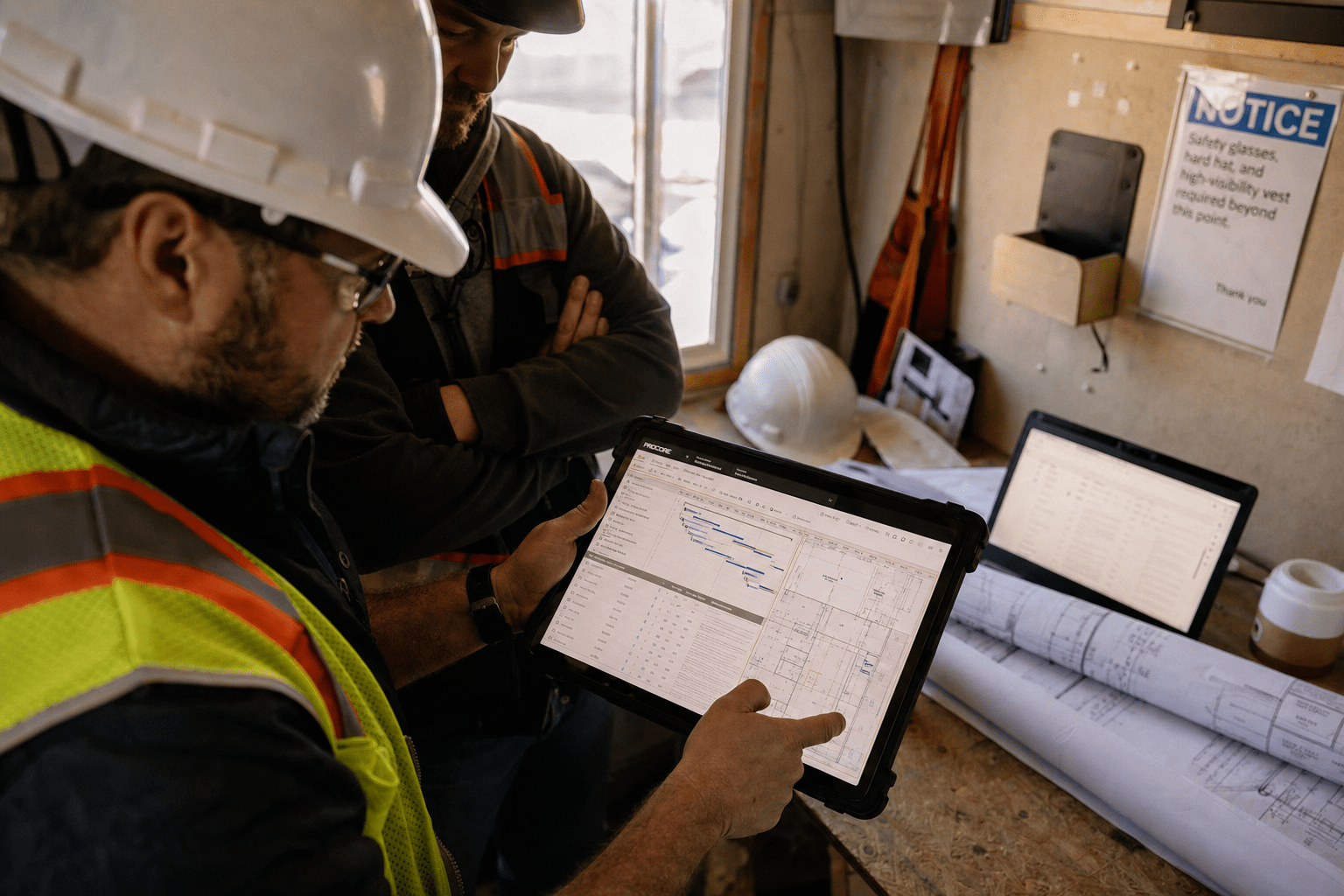
IT consulting for construction companies is the work of matching technology decisions to how a builder actually operates: split between a home office and a dozen moving jobsites, running project software that has to sync from a trailer, and protecting payment and drawing data that criminals now target directly. IT Consulting Construction starts on the jobsite, where connectivity, device access, software adoption, and field conditions determine whether technology works. It asks whether a foreman can pull the latest set of plans over a weak signal, whether field crews can log daily reports without fighting the app, and whether a stolen laptop hands over your bid history. When those answers hold up under real jobsite conditions, the technology earns its place.
The 5 Things Construction Leaders Should Know First
We have walked enough sites to know where construction technology breaks. These are the five points that shape every engagement.
- Construction IT lives in two worlds at once. The office runs accounting and estimating; the field runs schedules, plans, and daily logs. Tech that only serves one side creates rework on the other.
- Connectivity is the hidden bottleneck. A project platform is only as good as the signal feeding it, and most delays we see trace back to a trailer with no reliable link, not the software.
- Attackers have found the industry. Wire fraud and ransomware now hit builders because payment approvals and change orders move fast and involve real money.
- Software sprawl quietly drains margin. Procore, Buildertrend, Sage, and a stack of point apps rarely talk to each other, so crews retype the same data three times.
- Strategy beats break-fix. Firms that plan technology a year ahead spend less than firms that only call for help when a device dies mid-pour.
Why Generic IT Support Falls Short for Builders
IT Consulting Construction must account for mobile crews, temporary jobsites, unreliable connectivity, and the constant movement of devices and project data. A downtown accounting client and a road contractor look nothing alike once you leave the parking lot. The accountant sits at the same desk every day; the contractor moves crews across counties and expects the same data to follow them. A help desk that only knows desktops and printers cannot answer the question that matters most on a construction project, which is how to keep field data flowing when the site has no fiber and half the crew is on tablets.
There is a fair counterargument. Plenty of small builders run for years on a local repair shop and a cloud accounting login, and nothing catches fire. That works until the firm wins a bigger job, adds a second crew, or a client demands proof of data protection before signing. At that point the ad hoc setup becomes the constraint. Our team treats the transition honestly: if a break-fix arrangement genuinely covers your risk today, we say so, and we plan the upgrade for when growth actually forces it rather than selling you scale you do not need yet.
The practical test is simple. Ask whether your current support has ever visited a jobsite. If the answer is no, they are guessing at the conditions that decide whether your technology works. Our IT consulting practice starts by mapping both the office and the field so the plan reflects the whole business.
How Jobsite Connectivity Shapes Every Other Decision
Before selecting IT Consulting Construction, evaluate each provider’s approach to field connectivity, software integration, cybersecurity, support, and long-term planning. On one hand, cellular hotspots and modern routers make temporary sites workable, and a builder can stand up a usable link in an afternoon. On the other hand, dense structures, rural locations, and steel-heavy builds swallow signal, so the same gear that works on one site fails on the next. Neither view is wrong; the right answer depends on the actual site.
We plan connectivity per project, not per company. That means checking coverage before mobilization, keeping a backup path such as a second carrier or a bonded connection, and setting realistic expectations for crews about what syncs live versus what queues until they reach signal. When connectivity is treated as a first-class decision, project platforms stop looking unreliable, because the problem was never the software.
How Field and Office Data Stay in Sync
Field and office data stay in sync when there is one source of truth and a deliberate flow between the trailer and headquarters, rather than parallel spreadsheets that drift apart. The optimistic case is that platforms like Procore or Buildertrend already centralize this, and for many firms they do. The harder reality is that most builders bolt those platforms onto older accounting systems, so cost codes, change orders, and vendor data live in two places and rarely match.
Our approach is to map the data path first: where a daily report originates, who approves a change order, and how that hits the general ledger. Then we close the gaps with integrations or disciplined process instead of adding another app. The goal is fewer places to enter the same number, because every re-entry is a chance for an error that shows up later as a margin surprise.
How Software Choices Affect Field Adoption
Software choices succeed or fail on whether the crew in the field will actually use them, not on the feature list that impressed the office. A powerful platform that foremen ignore is worse than a simpler one they trust, because half-entered data corrupts every report built on top of it. Vendors will tell you their app is intuitive, and some genuinely are. Field crews will tell you a different story if the login times out on a weak signal or the form takes ten taps to submit.
We evaluate construction software the way a superintendent would: can it work offline, does it survive gloves and sunlight, and does it respect that a foreman has fifteen other tasks. Adoption is the metric that matters, so we pilot with a real crew on a real site before committing the whole company. That single habit prevents the expensive pattern of buying a platform, forcing it top-down, and watching field data quality collapse.
Where Cybersecurity Fits in Construction IT
IT Consulting Construction should include cybersecurity controls that protect payment processes, project files, email accounts, and shared data from fraud and ransomware. Builders move large payments on tight timelines, approve change orders by email, and share drawings across a web of subcontractors. That combination makes the industry an active target. The federal Cybersecurity and Infrastructure Security Agency documents how ransomware shuts operations down by locking the files a business runs on, and a builder mid-schedule has little tolerance for lost days.
The most common loss we see is not dramatic ransomware, it is wire fraud. An attacker watches email, learns a payment routine, then sends a convincing request to change bank details right before a draw. The defenses are unglamorous and effective: multi-factor logins on email, a verbal callback rule for any banking change, and backups that let you recover without paying anyone. Aligning these controls to the NIST Cybersecurity Framework gives a builder a plain checklist rather than a vague sense of risk. For firms that need a senior security voice without a full-time hire, our CISO consulting puts that expertise on call.
How to Plan Construction Technology a Year Ahead
IT Consulting Construction helps builders plan technology spending a year ahead, reducing emergency purchases and aligning investments with the project pipeline. Reactive firms replace equipment when it dies, often at the worst moment, and pay rush rates for both hardware and labor. Forward-planning firms know when laptops age out, when a project platform renewal lands, and how the next hire changes the setup.
A virtual CIO makes this practical for companies too small for a full technology executive. This role sets the roadmap, aligns spending to the project pipeline, and keeps security and connectivity on the agenda before they become fires. Our virtual CIO consulting gives builders that seat at the table without the cost of a senior salary. The output is a plain plan: what you will spend, when, and why, tied to the jobs you expect to win.
Frequently Asked Questions
What does IT consulting for construction companies actually include?
IT consulting for construction companies covers technology strategy, jobsite connectivity planning, construction software selection and integration, cybersecurity, and ongoing support built for a mobile business. The work spans both the home office and the field, because a builder runs in both places at once. A good engagement starts by mapping how your projects actually operate before recommending any product.
How is construction IT different from regular business IT?
Construction IT has to serve a workforce that moves between temporary sites with unreliable connectivity, while standard business IT usually supports a fixed office. That difference changes almost every decision, from how data syncs to how devices are protected against loss on a jobsite. Support that has never worked a live site tends to underestimate these conditions.
Do small construction firms really need cybersecurity help?
Yes, because attackers target the payment approvals and change orders that even small builders handle daily. Wire fraud in particular does not care about company size; it follows the money. Basic protections such as multi-factor email logins, a callback rule for banking changes, and tested backups stop most of what we see in the field.
Should we replace our construction software or fix how we use it?
Often the better move is to fix integration and adoption before replacing anything, since most builders already own capable platforms they use at half strength. Replacement makes sense when a platform genuinely cannot connect to your accounting system or crews reject it after a fair pilot. We test adoption with a real crew before recommending a switch.
How much does IT consulting for a construction company cost?
Cost depends on company size, number of active sites, and whether you need ongoing support or a one-time roadmap, so any honest answer starts with a conversation. Firms that plan ahead almost always spend less than firms that only call during emergencies. A free strategy call is the fastest way to get a realistic range for your situation.
Build a Technology Plan That Holds Up in the Field
Construction technology works when it is designed for the trailer as seriously as the office, protected against the fraud that targets builders, and planned around the jobs you expect to win rather than the crisis in front of you. That is the difference between IT that drags on a project and IT that quietly keeps it moving. Our team builds these plans by starting where the work happens, on the site, so the recommendations reflect real conditions instead of a generic template. If you are ready to see what a field-tested plan looks like for your firm, book a free strategy call and we will map your office and your jobsites together.

