

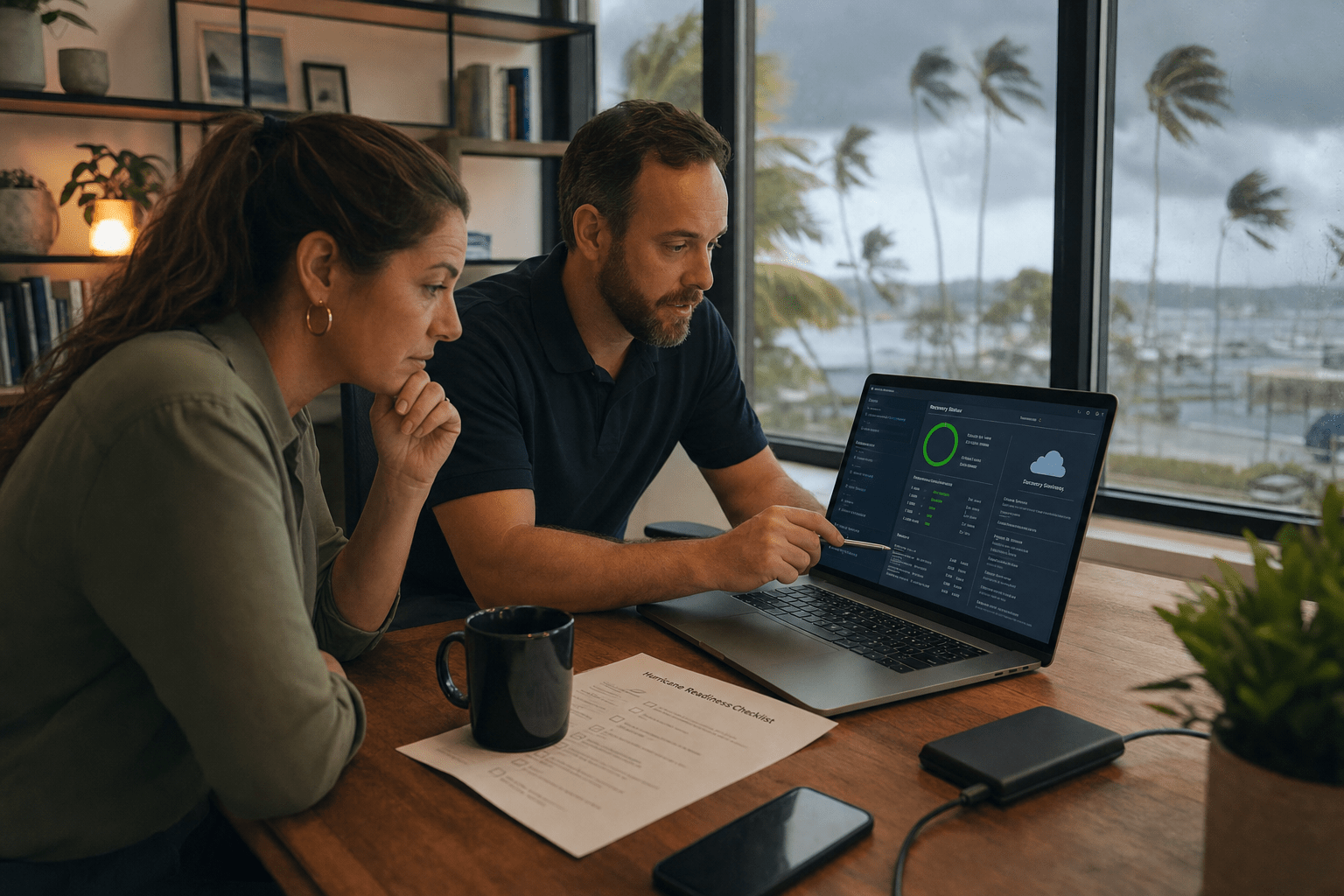
Backup and disaster recovery in Boca Raton FL has to assume something most plans ignore, that hurricane season can take the whole building and regional power for days at a time. Backup and Disaster Recovery Boca Raton must prepare South Florida businesses for literal disasters that can close offices and disrupt regional utilities. It is not only a failed hard drive or a ransomware note. It is a storm that makes the office unreachable during the exact week clients need you most. We work with Boca Raton and Palm Beach County firms that had backups and still could not operate after a storm, because the plan assumed someone could get to the office and the power would stay on. This guide covers the five risks we see most in local businesses and how to close each before the next season.
The 5 Principles of South Florida Recovery
Backup and Disaster Recovery Boca Raton works best when the plan keeps operations running even if the office and local power grid are unavailable. Here are the five ideas this guide returns to, written for owners and operations leads at South Florida firms with 10 to 500 people.
- The building may be unreachable. Hurricanes and flooding can close the office for days, so recovery cannot depend on being on site.
- Power and internet fail regionally. A storm can take out an entire area’s utilities, not just your office, so local-only backups are not enough.
- Recovery time is the real test. How fast you resume, not whether a copy exists, decides whether an outage is a bad week or a lost client.
- Ransomware does not wait for storms. Attacks target backups year round, so protection means isolated copies as well as storm readiness.
- Season is predictable, timing is not. Hurricane season is a known window, so a South Florida business has no excuse for an untested plan when it arrives.
Why South Florida Businesses Need More Than Backups
South Florida businesses need more than backups because the region’s disasters take the location, not just the data. In most of the country, disaster recovery planning centers on hardware failure and cyberattacks. In Boca Raton, the plan also has to survive a named storm that shuts the office and the neighborhood for days. The reader test is direct. If your recovery plan assumes someone can reach the building and the power will hold, it has not been written for South Florida. Structured business continuity and disaster recovery planning starts from the assumption that the office may be gone, and builds the business to run anyway.
Does a Local Backup Survive a Hurricane?
Backup and Disaster Recovery Boca Raton should include an off-site or cloud copy because local backups face the same hurricane, flood, and power risks as primary systems. On-site backups are fast to restore and keep data close, which is genuinely useful for everyday recovery. The counterargument is that in a regional disaster, close is exactly the problem. A drive in the same office as your servers offers no protection when the whole building floods. Both points hold. The workable answer is a layered approach, keeping a fast local copy for routine recovery and an off-site or cloud copy that survives a storm hitting the region. Our comparison of cloud backup versus local backup walks through where each layer fits for an SMB.
How Should a Boca Raton Business Set Recovery Goals?
A Boca Raton business should set recovery goals around how long it can operate with the office unreachable, then build backward from there. Two planning terms anchor this. Recovery time objective, or RTO, is how quickly you need systems back. Recovery point objective, or RPO, is how much recent data you can afford to lose. During a storm, RTO matters most, because the question is how fast you can serve clients from somewhere other than a closed office. Some argue every business should buy the fastest recovery available. Others argue that overspends for firms that can pause briefly. The measured answer sets RTO and RPO per system against your real tolerance, especially for the systems clients touch. We size a plan to those numbers so you are ready for the season without paying for more than you need. For firms weighing in-house versus outside help, our look at in-house versus outsourced options in Boca Raton is a useful starting point.
The 5 Risks Boca Raton SMBs Miss With Recovery
The five risks below are the ones we find most when a South Florida business asks us to review its recovery plan, and each one shows up worst during hurricane season.
Risk 1: A Plan That Assumes the Office Is Reachable
The most common local risk is a recovery plan that quietly assumes staff can reach the office and the power will hold. During a hurricane, both assumptions can fail for days. The federal Ready.gov hurricane guidance stresses planning for extended loss of facilities and utilities, not a brief outage. We design recovery so systems live in the cloud and staff can work from anywhere with documented remote access. The goal is a business that keeps serving clients even when the building is dark and the roads are closed.
Risk 2: Backups an Attacker or Storm Can Destroy at Once
A serious risk is keeping backups where a single event, storm or ransomware, can destroy them along with the originals. A drive in the same office dies in the same flood, and a backup on the same network gets encrypted in the same attack. The Cybersecurity and Infrastructure Security Agency’s StopRansomware guidance calls for isolated, immutable backups an attacker cannot reach. That same isolation protects against a physical disaster. We build at least one recovery copy that lives off-site and cannot be altered, so neither a hacker nor a hurricane takes both your systems and your way back.
Risk 3: No Tested Restore Before the Season
A reliable Backup and Disaster Recovery Boca Raton strategy includes tested restores before hurricane season so recovery problems are corrected while conditions are calm. Backup software reports success while silently skipping a database or a permissions error, and no one notices until recovery is urgent. We run test restores ahead of hurricane season, time them against your RTO, and fix what breaks while it is still calm. A backup you have recovered from is protection. A backup you have never tested is a hope you are betting the business on.
How to Choose a Recovery Partner in Boca Raton
Choosing a Backup and Disaster Recovery Boca Raton partner depends on whether they understand regional risks, maintain the plan continuously, and prove recovery works. The final two risks are about ongoing ownership, which storms expose fast.
Risk 4: No One Keeps the Plan Current
A quiet but costly risk is having no one responsible for keeping the recovery plan up to date as the business changes. Systems get added, staff turn over, and the plan written two years ago no longer matches reality when a storm arrives. Assigning an internal owner helps but usually loses to daily work. A managed partner closes the gap by owning the plan as a standing duty. Through ongoing disaster recovery management, we keep your plan current year round so it reflects the business you run now, not the one you ran before your last growth spurt.
Risk 5: Treating Cloud Backup as Set and Forget
A common mistake is setting up cloud backup once and assuming it will simply work when needed. Cloud backup is powerful, and it still needs monitoring, testing, and configuration as systems change. Left unchecked, it can silently stop protecting a new server or application. We manage cloud backup as an ongoing service, verifying that every system that matters is covered and recoverable. The point of moving backups to the cloud is resilience against a regional disaster, and that resilience only holds when someone is watching it.
Frequently Asked Questions
Why do Boca Raton businesses need special disaster recovery planning?
Boca Raton businesses need disaster recovery planning built for hurricanes because a storm can make the office and local utilities unreachable for days. A plan that assumes staff can reach the building or the power will hold fails exactly when it is needed. South Florida recovery has to keep the business running from anywhere.
Will my cloud backup protect me during a hurricane?
A cloud backup protects your data during a hurricane because it lives off-site, away from the storm hitting your building. It only delivers full protection when it is monitored and tested, and when your team can access systems remotely. Cloud backup paired with documented remote access is what keeps you operating through a storm.
How often should I test my disaster recovery plan?
You should test your disaster recovery plan at least once before each hurricane season, and after any major system change. Testing confirms a restore actually works and measures how long it takes against your recovery goals. Many failed recoveries trace back to backups that were never once restored.
What is the difference between backup and disaster recovery?
Backup is the copy of your data, while disaster recovery is the tested process of getting your business running again after an event. Backup answers whether the data exists. Disaster recovery answers how fast and how completely you resume operations, which matters most when a storm closes the office.
How much does disaster recovery cost for a small business in Boca Raton?
Disaster recovery cost is best measured against the cost of being down during a storm or attack rather than as a flat fee. A firm that loses significant revenue per day of closure justifies faster recovery than one that can pause. A right-sized plan matches spending to your recovery time and data-loss tolerances.
Get a Recovery Plan Built for Boca Raton
Backup and disaster recovery in Boca Raton FL is really a keep-operating question, because the region’s disasters take the office and the grid, not just the data. The five risks above share one root, which is planning for lost files instead of a lost location. A plan that assumes a reachable office, backups a single event can destroy, no tested restore before the season, no one keeping the plan current, and set-and-forget cloud backup each look fine until a named storm proves otherwise. The businesses that come through a season well do not spend the most. They plan for the office to be gone, protect their backups from both storm and attack, and prove the plan works while it is calm. We help South Florida firms build recovery that holds when the weather does not. If you want to know how your business would really fare in the next storm, book a free strategy call and we will walk your plan with you.

