

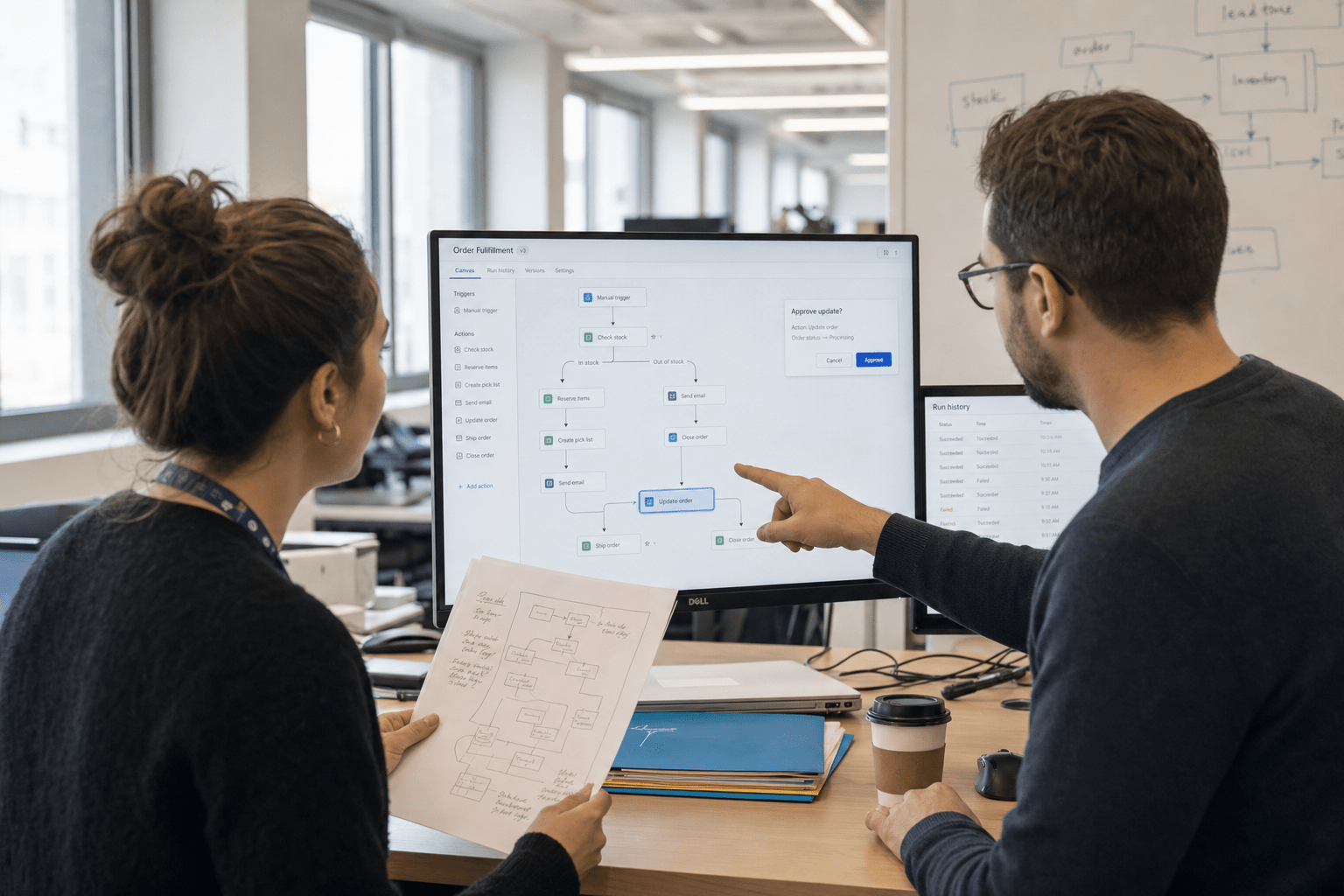
Most advice on autonomous workflow agents starts one step too late. It tells you to add approval gates, keep audit logs, and scope permissions tightly, all of which is sound. But it assumes the decision to hand the workflow over has already been made correctly, and that is where the expensive mistakes happen. Some processes are a poor fit for an autonomous agent no matter how carefully you wrap them in controls, and you can identify those in advance by looking at the process rather than the technology.
This autonomous workflow agents guide is about that earlier question. Before you choose a single guardrail, six properties of the work itself tell you whether an agent belongs there at all. We put them in the order we actually use them, because one of the six outranks the rest.
Selection Comes Before Controls
An autonomous agent differs from an ordinary automation in one way that matters: it decides. A traditional script follows a path you wrote, so its worst case is bounded by that path. An agent chooses which action to take next, so its worst case is bounded by the permissions you gave it and nothing else.
That is why controls alone cannot rescue a bad fit. Guardrails narrow what an agent may do, but they cannot tell you whether the underlying work has a shape an agent can succeed at. When something goes wrong in a badly chosen workflow, it goes wrong at machine speed and across every record the agent could reach, which is a different category of problem from a script failing on one row.
We walk clients through the six checks below before scoping any agent build. If a workflow fails the first three, no amount of oversight design makes it a good candidate this year. If it passes, the remaining three tell you how much supervision to budget for. For the wider security picture once a build is underway, our overview of the security risks of using AI agents in business workflows covers the threat side in more depth.
Risk 1: You Cannot Undo What It Does
Reversibility is the first check and the one we weight most heavily. Ask a plain question about the workflow’s final action: if the agent does it wrong four hundred times overnight, what does the recovery look like?
Some actions reverse cleanly. A draft created in the wrong category is edited. A ticket routed to the wrong queue is moved. A calendar hold is deleted. The cost of being wrong is a few minutes of somebody’s attention.
Other actions do not reverse at all. Money that has left by wire is gone in a way that a database row is not. An email sent to two thousand customers cannot be recalled. A permission revoked at the wrong moment locks out the person who needed it. A record deleted from a system with no soft-delete is a restore-from-backup event.
Sort every candidate workflow by that answer before anything else:
- Fully reversible. The agent can act without a human in the path, because mistakes cost cleanup time rather than money or trust.
- Reversible with effort. The agent can act, but you want the change staged rather than applied, so a human confirms in bulk.
- Not reversible. The agent prepares the action and a human executes it. This is not a temporary limitation while you build confidence. It is the permanent design for that class of work.
Teams get this wrong in a specific way. They reason that accuracy has been high in testing, so the irreversible step is safe to release. Accuracy is the wrong variable. The question is what the failure costs when it eventually happens, and an irreversible action with a small failure rate is still an unbounded loss.
Risk 2: Nobody Has Written Down the Happy Path
The second check is determinism. Can somebody in the business describe, in order, what correct handling of this work looks like from start to finish?
If the answer is no, the process is not ready. This sounds like a documentation problem and it is really a knowledge problem: the rules live in one experienced person’s judgment, and they have never been made explicit because they never needed to be. An agent handed that work does not inherit the judgment. It infers a rule from whatever context it can see, and it will infer confidently and wrongly at the edges.
The practical test we use is simple. Ask two people who do the work to write the steps separately, then compare. Where they agree, you have a defined process. Where they disagree, you have found the judgment that has to be resolved by a human before it can be encoded, not after.
This is also why the best first agent build is usually a process somebody already regards as tedious and obvious. Our walkthrough on scaling business processes from manual to autonomous works through that progression, and the step-by-step guide to building a first workflow is a reasonable place to start if you are choosing a pilot.
Risk 3: The Exceptions Outnumber the Rule
The third check is exception density. Count how often real cases follow the documented path versus needing a human to intervene.
There is a threshold that decides the economics. When roughly nine in ten cases run clean, an agent removes real work and the exceptions get proper attention because there are few of them. When only half run clean, you have built something worse than the manual process: a reviewer now reads every case to determine whether the agent handled it correctly, which is slower than doing the work, and attention degrades exactly as volume rises.
Measure this before you build, not after. The number is usually available from whatever queue or ticket system already holds the work, and it is the single most reliable predictor we see of whether an agent build pays for itself. High exception density is not permanently disqualifying, but the fix is to narrow the workflow to the subset that runs clean rather than to accept the ratio and add reviewers.
Risk 4: You Cannot Tell What It Did
If a workflow clears the first three checks, the remaining questions are about supervision. The first of those is evidence.
An agent that acts without leaving a legible trail cannot be supervised, no matter how many people are assigned to supervise it. What you need is not a raw model log but a record a non-engineer can read: what the agent was asked, what it decided, which action it took, what changed as a result, and when. Without that, two things become impossible. You cannot investigate a specific complaint, and you cannot tell the difference between an agent that is working and one that has been quietly wrong for a month.
Decide the evidence format before the build rather than after, because retrofitting it usually means re-instrumenting the whole workflow. Our note on whether AI agents are safe for enterprise use goes further into what an adequate trail contains.
Risk 5: Its Authority Is Wider Than Its Job
The fifth check is scope. Agents are typically given credentials for a system rather than permissions for a task, because that is the path of least resistance during a build. A mailbox agent gets full mailbox access when it needed to read one folder. A finance agent gets the payables role when it needed to read invoices and write a draft.
That gap between granted authority and required authority is the blast radius. It costs nothing while the agent behaves and it defines your worst case when the agent misfires or when its instructions are manipulated by content it processes. The discipline is to write down the smallest permission set the task genuinely needs, then provision exactly that, and to treat any widening as a change that gets reviewed. Our guidance on the best way to secure autonomous AI agents covers the mechanics of tightening this down.
Risk 6: No Named Person Owns the Output
The last check is accountability, and it is the one most often skipped because it is not technical. Somebody has to own the agent’s work in the same way a manager owns a team member’s work: they see what it produced, they hear about it when it is wrong, and they have the authority to stop it.
Agents that fail quietly usually fail because ownership was diffuse. The build was an IT project, so operations assumed IT was watching, and IT assumed operations would notice bad output. Both are reasonable assumptions and together they produce nobody. Name one person per agent, give them a weekly look at what it did rather than only an alert when it breaks, and make stopping it a decision they can take alone without escalating.
Putting the Six Checks to Work
Run the checks in order and let the answers set the design:
- Fails reversibility, determinism, or exception density: keep it manual for now, or narrow the scope until it passes. Do not compensate with controls.
- Passes all three: build it, and let checks four through six size the supervision. Reversible plus well-defined plus low exception density means light oversight. Anything with an irreversible step keeps a human executing that step permanently.
The pattern we see across successful builds is unglamorous. The first agent handles work that is boring, well understood, high volume, and completely reversible. It earns trust, the evidence trail proves what it did, and the second build is chosen on the same criteria rather than on ambition. For a view of where this leads once the basics hold, our piece on AI agents as the next evolution of business automation sets out the longer arc, and our AI agents service page explains how we scope these builds with clients.
If you are weighing a first autonomous workflow and want a second opinion on whether it is the right candidate, book a free strategy call and we will run your process through these six checks with you.
Frequently Asked Questions
What is an autonomous workflow agent?
It is software that carries out a business process end to end while choosing its own next action, rather than following a fixed sequence a developer wrote. That decision-making ability is what makes it useful on varied work, and it is also why the permissions you grant it define your worst case.
Which processes should I automate with an agent first?
Pick work that is high volume, well documented, boring to the people doing it, and completely reversible if handled wrongly. Those four properties together mean a mistake costs cleanup time rather than money or customer trust, which is what makes a first build safe to learn from.
Should a human always approve what an agent does?
No, and requiring it everywhere is what makes agent projects fail to save time. Match the oversight to reversibility. Fully reversible actions can run unattended with a weekly review of what happened, while any irreversible step keeps a human executing it permanently.
How do I know if my process has too many exceptions to automate?
Count how many real cases in the last month followed the documented path without a human stepping in. Around nine in ten is a workable starting point. Near half means a reviewer would have to check everything, which costs more than the manual process, so narrow the workflow to the subset that runs clean.
What is agent blast radius?
It is the total damage an agent could do with the access it holds, as opposed to the damage its intended task requires. An agent given a whole system’s credentials to read one folder has a blast radius far wider than its job, and closing that gap is one of the cheapest risk reductions available.

