

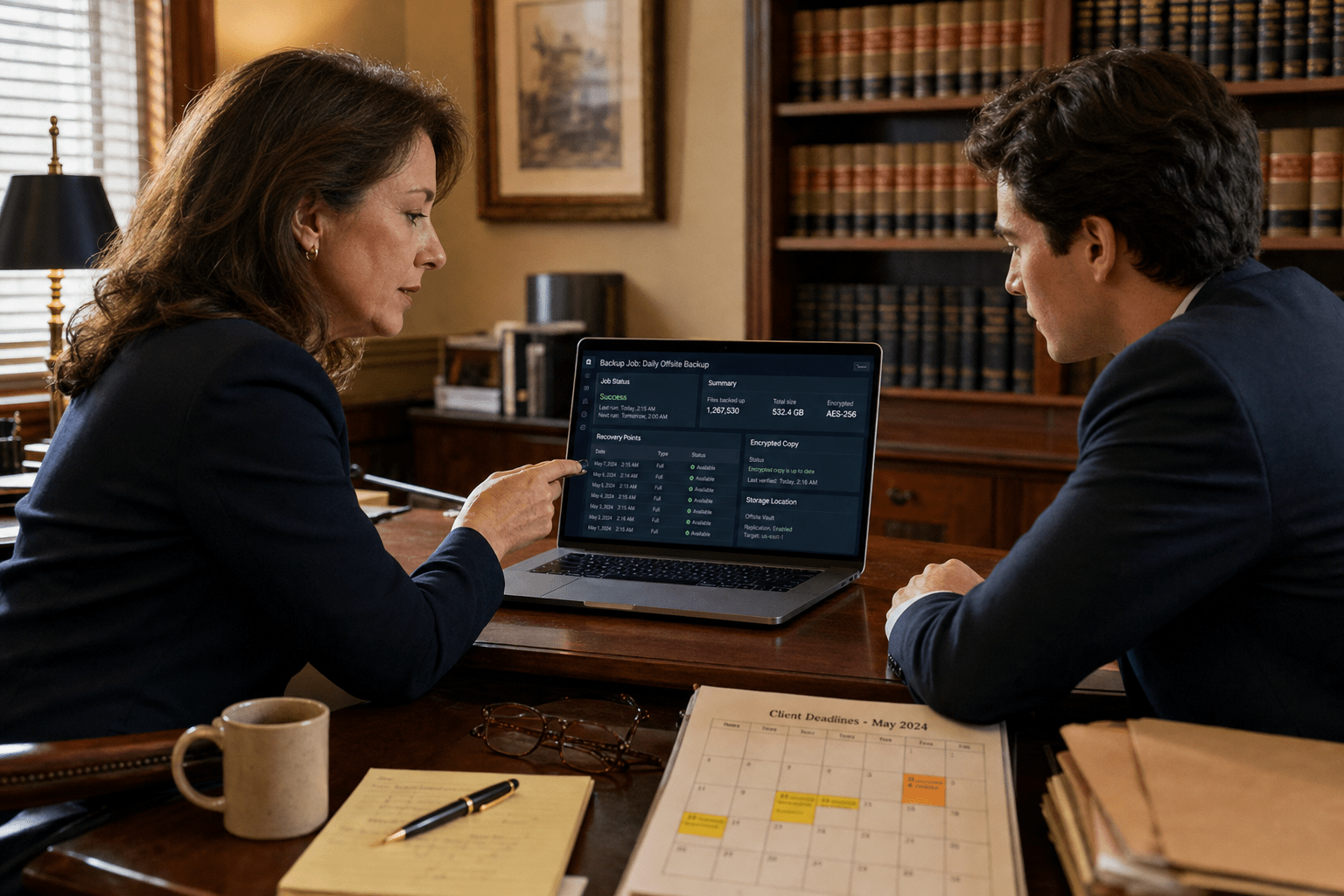
Backup and disaster recovery for professional services firms is a different calculation than it is for a retailer or a warehouse, because the asset at risk is not inventory, it is client trust and the deadlines that trust is built on. A law firm that loses access to case files the week a filing is due, an accounting practice locked out during tax season, or an agency that cannot reach a client deliverable the day it ships, all face the same thing: the disaster is not the data loss itself, it is the commitment you cannot keep while you recover. That reframing matters, because it changes what a firm should buy. A plan sized to a generic restore window can still miss the deadline that actually costs you the client. This guide explains what backup and disaster recovery should look like for Professional Services Firms whose recovery timelines are dictated by client commitments.
Why Professional Services Firms Face a Distinct Risk
Professional Services Firms carry a risk profile that generic backup plans were not designed for, including confidential client data, hard deadlines, and revenue measured in billable hours. When systems go down, a manufacturer loses production it can often catch up. A firm loses hours that were already promised, and sometimes a filing window that does not reopen. The federal Ready.gov business guidance frames continuity around the disruptions that would actually stop your operation, and for a firm that disruption is losing access to the work product clients are waiting on. A plan built on that understanding pairs business continuity and disaster recovery design with the firm’s real calendar, not just its data volume.
The Deadline Is the Disaster
For Professional Services Firms, the deadline is often the real disaster, which is why recovery targets must reflect client commitments rather than generic restore windows. A backup vendor sells you the ability to recover data, and that is genuinely useful. But if recovering that data takes two days and your client deadline is tomorrow, the recovery succeeded and the firm still failed. The honest counterview is that not every system is deadline-critical, and paying for instant recovery on everything would be waste. The work is separating the systems tied to client commitments, the document management, the email, the practice or case software, from the ones that can wait. Those critical systems need a recovery time measured against filing dates, which is exactly how our disaster recovery planning frames the targets for a firm.
Confidentiality Raises the Stakes on Every Copy
Confidentiality raises the stakes because every backup copy of your data is another copy an attacker or a careless process could expose. A firm holds privileged, regulated, and sometimes legally protected client information, so a backup is not just an operational safeguard, it is a confidentiality obligation. The counterargument that more copies always mean more safety holds only for availability. For confidentiality, an unsecured or unencrypted backup is a liability, not a protection. Firms subject to the FTC Safeguards Rule or similar obligations have to be able to show that backup copies are encrypted, access-controlled, and accounted for, which is where managed security services and backup design have to be planned together rather than bolted on separately.
What a Firm-Ready Recovery Plan Includes
A recovery plan for Professional Services Firms should start with the client calendar and work backward to define storage, restoration, and continuity requirements. That means classifying systems by how close they sit to a client commitment, setting recovery targets against real deadlines, encrypting every copy, and keeping at least one copy in a location a local incident cannot reach. The NIST Cybersecurity Framework treats recovery as a capability you validate rather than a product you buy, and for a firm that validation is a rehearsal against a realistic scenario, not a checkbox. The firms that recover cleanly are the ones that ran the drill before the real thing.
Recovery Time Targets Tied to Client Commitments
Recovery time targets for a firm should be written in the language of client work, not just IT metrics. Instead of a vague goal to be back up soon, the target is a concrete answer: if the document system fails on a Tuesday, the firm can be working in it again within a set number of hours, well inside the window before any current deliverable is due. Setting that number forces an honest conversation about cost, because faster recovery costs more and not every system justifies the top tier. A shared drive of old marketing files does not need the same target as the active case or client folder. Matching the target to the commitment is how a firm avoids both overpaying and under-protecting.
Tested Restores, Not Just Successful Backups
Tested restores are the difference between a plan and a paperwork exercise, and firms are especially exposed here because they rarely have spare IT capacity to run the test. A backup job that reports success every night still carries an untested assumption that the restore will work when it counts. Restores fail for ordinary reasons: a corrupted image, a missing application dependency, credentials no one documented. For a firm mid-deadline, discovering that during the emergency is the worst possible time. We run scheduled recovery tests as part of ongoing managed IT services precisely so the first real restore is never the first restore anyone has attempted.
Ransomware and the Firm as a Target
Ransomware has made Professional Services Firms favored targets because attackers exploit deadline pressure, confidential client data, and the financial cost of prolonged downtime. That reality changes backup design, because modern attacks specifically hunt for and encrypt backups before triggering the main event. A backup that stays connected and writable is a backup an attacker can destroy. The response is an immutable copy, one that cannot be altered or deleted for a set retention window, kept separate from the production network. Some will argue immutability is overkill for a small practice, and a few years ago that held more weight. Today small and midsize firms sit squarely in the target set, and an immutable, offline-capable copy is often the single control that turns a ransomware event from a shutdown into an inconvenience. Pairing that with tested recovery and encrypted copies covers the two scenarios most likely to actually hit a firm: an attacker, and an ordinary failure at the worst moment.
Frequently Asked Questions
What makes backup and disaster recovery different for a professional services firm?
The critical asset is client work tied to hard deadlines, not physical inventory. That means recovery time has to be measured against filing dates and client commitments, and every backup copy also carries a confidentiality obligation because it holds privileged client data. A plan built for a generic business can recover the data and still miss the deadline that matters.
How fast should a firm be able to recover its systems?
Fast enough to stay inside the window before your next client deadline. The right target depends on which system fails and what commitment it supports, so critical systems like document management and practice software need aggressive recovery times, while archival data can tolerate a slower restore. Setting these targets against the real calendar is the core of firm-ready planning.
Are our client files safe in a cloud backup?
If you’re still comparing cloud storage providers before settling on a backup architecture, our roundup of the best cloud storage options for individuals and businesses covers pricing and security features across the major platforms. They can be, when the backup is encrypted, access-controlled, and kept in a secure region. A cloud backup handled carelessly is a confidentiality risk, but one designed with encryption and proper access controls often protects client data better than an on-premises copy. The design and the security controls are what determine safety, not the location alone.
Does ransomware really target small firms?
Yes. Attackers view firms with confidential data and deadline pressure as more likely to pay, and modern ransomware seeks out and encrypts backups first. An immutable backup copy that cannot be altered or deleted is often the control that lets a firm recover without paying a ransom.
How often should we test our recovery plan?
At least once a year, and after any major change to your systems. A backup that has never been restored is an assumption. Scheduled tests confirm the copy is usable, the recovery times are realistic, and the people involved know the steps before a real incident forces them to improvise.
Protect the Deadlines Your Clients Count On
Backup and disaster recovery for professional services firms comes down to one honest question: if your systems failed today, could you still meet the client commitment due this week? A plan that answers yes is built backward from your calendar, with recovery targets tied to deadlines, encrypted and accounted-for copies that satisfy your confidentiality duties, an immutable copy that ransomware cannot reach, and restores that have been tested before anyone needed them. None of that is out of reach for a small or midsize firm, and all of it is far cheaper than the client you lose to a missed deadline. If you want a clear read on where your current backup would leave you exposed during your busiest stretch, our team will map your systems against your real deadlines and build a recovery plan sized to the work your clients are waiting on. Book a free strategy call and we will start with the restore test most firms have never run.

