

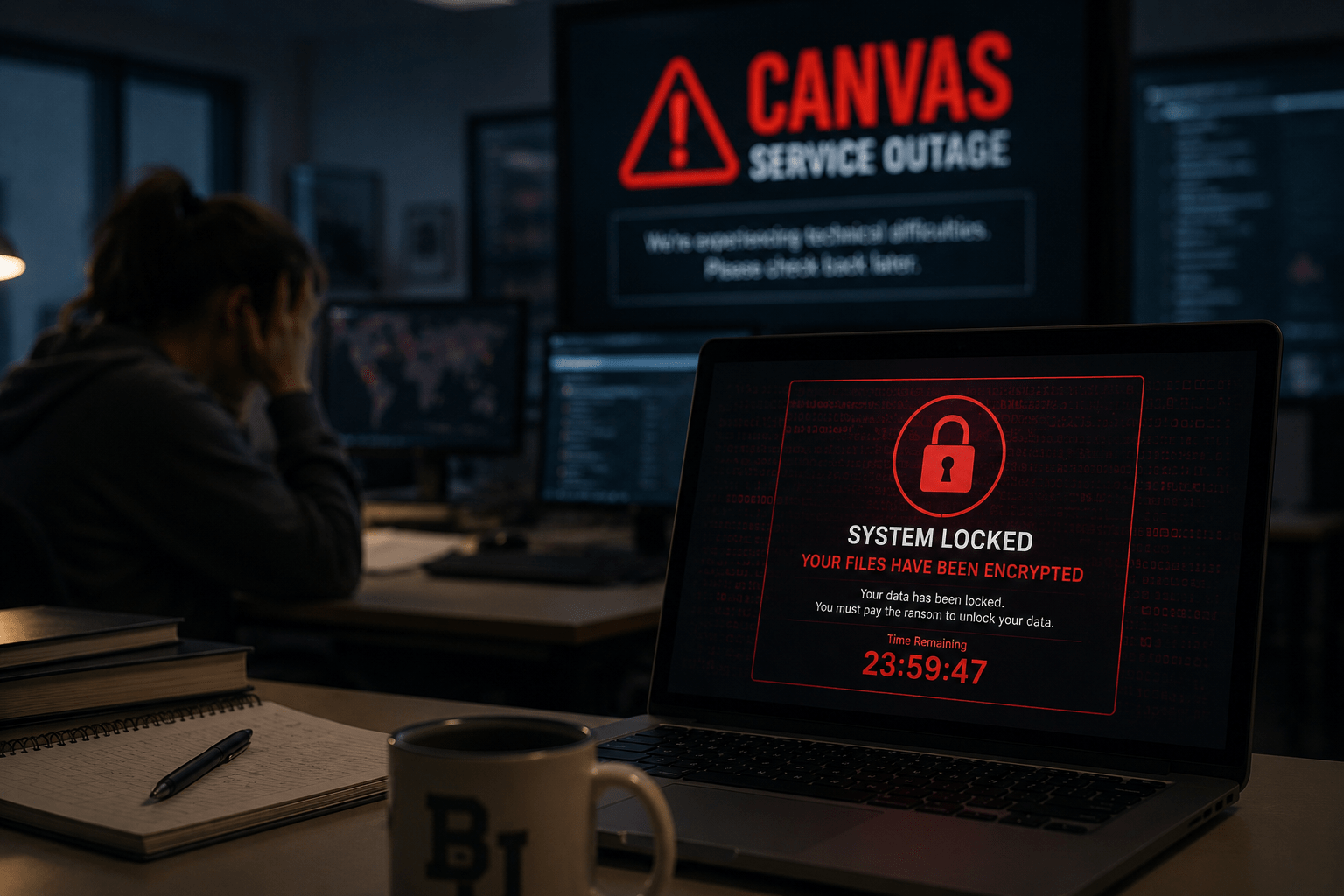
Finals week is already one of the most stressful periods in the academic calendar. For students, faculty, and administrators at universities across the country, this year it came with an added crisis: a cyberattack that took down one of the most widely used learning platforms in higher education.
The Canvas attack was not a minor disruption. It was a large-scale ransomware incident that forced exam rescheduling, raised serious questions about data exposure, and put cybersecurity in the national conversation at a moment when millions of people were paying attention.
Here is what happened, what it means for anyone whose data may have been affected, and what it reveals about the state of cybersecurity in institutions that millions of people depend on every day.
Organizations evaluating platform resilience should review layered cybersecurity services, third-party risk management strategies, and identity protection controls before a platform-level incident occurs.
What Is Canvas and Why Does It Matter
Canvas is a learning management system developed by Instructure. It is one of the most widely adopted educational platforms in the world, used by universities, colleges, K-12 schools, and corporate training programs.
The scale of its adoption is what made this attack significant.
Cybersecurity expert James Turgal put the numbers in perspective: “When you hit a platform, it’s not like hitting an individual application. You’re literally hitting the platform that affects probably some 9,000 schools and up to 275 million students, teachers and staff.”
When a platform at that scale is compromised, the ripple effect reaches far beyond any single institution.
Institutions increasingly dependent on cloud-based learning and collaboration platforms should also evaluate Zero Trust security frameworks and secure workspace solutions designed to contain risk and reduce exposure.
What Happened in the Canvas Attack
A ransomware group called ShinyHunters claimed responsibility for the attack. The group allegedly threatened to release personal data belonging to students, faculty, and staff unless ransom payments were made.
The attack caused widespread outages across colleges and universities nationwide. Baylor University in Waco, Texas was among the affected institutions.
Canvas access at Baylor was disrupted during finals week, forcing the university to reschedule Friday final exams for the following week. Other exams continued as scheduled where possible.
Baylor officials confirmed that Canvas access was restored Friday afternoon and stated they did not expect the situation to impact commencement ceremonies.
However, broader questions about what data was accessed and who was affected remained open as investigators continued their work.
Organizations preparing for disruptive cyber events should assess incident response planning, business continuity strategies, and ransomware protection measures.
Who Is ShinyHunters
ShinyHunters is a well-documented ransomware and data extortion group with a history of high-profile attacks on large platforms and organizations.
Their model combines two forms of leverage. First, they encrypt or disrupt access to systems, creating operational pressure to pay. Second, they threaten to publicly release stolen data, creating reputational and regulatory pressure.
This dual-extortion approach has become standard practice among sophisticated ransomware groups because it maximizes leverage against victims.
ShinyHunters has previously claimed responsibility for attacks on major consumer platforms involving hundreds of millions of user records.
Their targeting of Canvas fits a consistent pattern: high-volume platforms with sensitive personal data and a large, pressure-sensitive user base.
Businesses concerned about modern ransomware threats should review network security monitoring, managed security services, and penetration testing services.
What Data May Have Been Exposed
The specific scope of data exposure in the Canvas attack was still under investigation at the time of the incident.
However, based on the type of data learning management platforms typically hold, affected individuals should be aware of the potential exposure of:
- Full names and contact information
- Email addresses and login credentials
- Student ID numbers
- Academic records and course history
- Financial aid information in some cases
- In some institutional configurations, social security numbers or government identification
The combination of personal identifiers and institutional data makes education platform breaches particularly valuable to attackers.
This data can be used for identity theft, targeted phishing, financial fraud, and credential stuffing attacks on other platforms.
Organizations storing sensitive user information should evaluate IT risk assessments and stronger multi-factor authentication controls to reduce credential-related exposure.
What the Response Looked Like on the Ground
At Baylor and other affected institutions, administrators faced the challenge of managing both the technical response and the operational disruption simultaneously.
Finals week timing was not coincidental. Ransomware groups deliberately target high-pressure moments when organizations are least able to absorb disruption and most likely to prioritize rapid restoration over careful incident management.
The pressure to restore platform access quickly can lead to decisions that compromise a thorough investigation.
Cybersecurity expert James Turgal urged those who may have been affected not to panic while also taking immediate protective action: “Immediately change your passwords on all your email addresses, online banking, any of those. If they’ve got credit cards, I’m freezing those credit cards and freezing their credit reports.”
That is sound advice regardless of whether your specific data was confirmed to be exposed.
In the context of a large-scale platform breach, assuming potential exposure and acting accordingly is the safer approach.
The Cybersecurity Expert Perspective
Matt Rosenthal, CEO of Mindcore Technologies, connected the Canvas attack to the pattern his team sees across every industry: breaches that start with human behavior and are made worse by the absence of basic security controls.
“Almost every single breach that we deal with, and we deal with them every single day, somebody either clicked on an email that had a link in it, or they actually clicked on it, opened it and entered some information. As soon as you do that, you’re giving people a key to the front door.”
The entry point for the Canvas attack has not been fully disclosed publicly. But the broader lesson Rosenthal identifies applies directly: the combination of phishing-resistant authentication, security awareness, and basic hygiene practices would reduce the success rate of attacks like this significantly.
His recommendation on MFA is unambiguous: “You’ve got to turn that on for every single account that you have. It should be your email, the banks, the credit cards. If you don’t have that turned on, you’re literally asking for a problem.”
Organizations looking to reduce human-layer risk should implement security awareness training, phishing simulations, and organization-wide authentication enforcement.
What to Do If You Were Affected
If you are a student, faculty member, or staff member at an institution that uses Canvas, treat this as a potential exposure event and take action now regardless of whether you have received official notification.
Immediate Steps
- Change your Canvas password immediately – Use a strong, unique password not used on any other platform
- Change passwords on any account using the same credentials – Credential reuse allows a single breach to expand into multiple account takeovers
- Enable MFA on your email account – Your email is the recovery method for nearly every other account you own
- Enable MFA on financial accounts – Banking, credit cards, and investment accounts should require a second authentication factor
- Monitor your financial accounts – Watch for transactions you do not recognize
- Place a credit freeze – A freeze prevents new accounts from being opened in your name
- Check your credit report – Look for unfamiliar accounts or inquiries
Ongoing Monitoring
- Sign up for credit monitoring if you do not already use it
- Watch for phishing emails referencing the Canvas breach
- Be skeptical of messages asking you to click links or provide information related to the incident
Individuals and organizations should also review data breach prevention practices and security breach response strategies to better prepare for future incidents.

What This Means for Higher Education Cybersecurity
The Canvas attack is part of a broader pattern of ransomware targeting educational institutions.
Schools and universities present an attractive combination of characteristics for attackers:
- Large volumes of personal data
- Constrained cybersecurity budgets compared to many private-sector organizations
- High sensitivity to operational disruption
- Large numbers of non-technical users susceptible to phishing attacks
The consolidation of educational technology onto a small number of large platforms compounds this risk.
When a single platform serves 9,000 institutions, securing that platform becomes a shared responsibility with enormous collective consequences if it fails.
For institutions, the Canvas attack raises questions that go beyond this specific incident:
- What platforms does your institution depend on and what is your exposure if they are breached?
- What data do those platforms hold and what are your notification obligations if that data is exposed?
- Do you have a tested incident response plan covering third-party platform breaches?
- Are you enforcing MFA across all institutional accounts including student and faculty access?
These are not hypothetical questions after the Canvas attack. They are operational requirements.
Educational institutions modernizing cybersecurity programs should evaluate cybersecurity compliance services, co-managed IT services, and ongoing managed IT support.
FAQ: The Canvas Cyberattack
What happened in the Canvas cyberattack?
A ransomware group called ShinyHunters claimed responsibility for an attack on the Canvas learning management platform that disrupted colleges and universities nationwide during finals week. The group allegedly threatened to release personal data unless ransom payments were made.
Was my data exposed in the Canvas attack?
The full scope of exposure was still under investigation. Anyone using Canvas through an affected institution should treat the incident as a potential exposure event and immediately change passwords, enable MFA, and monitor financial accounts.
What is ShinyHunters?
ShinyHunters is a ransomware and data extortion group known for targeting large platforms with significant user data. Their attacks often combine operational disruption with threats to publicly release stolen information.
How do I protect myself after a platform breach?
Change passwords immediately, enable multi-factor authentication, monitor financial activity, consider freezing your credit, and stay alert for phishing attempts referencing the breach.
The Bottom Line
The Canvas cyberattack is a reminder that the platforms individuals and institutions depend on carry real risk.
That risk does not eliminate itself through good intentions or institutional reputation. It is managed through specific security controls, preparation, and a willingness to respond quickly when an incident occurs.
For individuals, the actions are clear: change passwords, enable MFA, monitor accounts, and stay alert for follow-up attacks.
For institutions, the conversation is more complex but equally urgent.
Mindcore Technologies works with organizations across industries to build security programs that address both direct threats and the platform dependencies representing growing risk in every sector.
If your organization does not have a clear picture of its third-party platform risk, that is the conversation to start today.
Schedule a consultation with Mindcore to evaluate your third-party exposure, strengthen authentication controls, and build a stronger response strategy before the next platform-level incident occurs.

