
Understanding What Is the Difference Between Business Continuity and Disaster Recovery helps businesses see how disaster recovery restores technology while business continuity maintains overall operations during a disruption. Knowing What Is the Difference Between Business Continuity and Disaster Recovery clarifies that disaster recovery focuses on technology restoration, while business continuity encompasses people, communication, and operations. Both matter, and one without the other leaves a hole. We see growing companies buy backup and failover tooling, then assume they have continuity covered. They do not. They have the IT half, and the half that decides whether the business keeps earning revenue during the outage is still missing.
The Five Points That Settle the Confusion
If you own IT or operations at a 50 to 500 person company, these are the points worth remembering:
- Disaster recovery is a subset of business continuity, not a synonym for it. Continuity is the larger plan, and recovery sits inside it.
- Recovery answers a technical question: how do we get systems back? Continuity answers a business question: how do we keep operating until they are back?
- Continuity planning starts with a business impact analysis that ranks which functions cannot stop, not which servers matter most.
- Understanding What Is the Difference Between Business Continuity and Disaster Recovery ensures companies measure recovery plans with RTO and RPO, while continuity plans are evaluated based on operational flow and customer service.
- You need both documented, tested, and owned by named people, or neither protects you when the pressure is real.
Why Companies Treat the Two as One Thing
Companies treat disaster recovery and business continuity as one thing because the tooling vendors sell sits on the IT side, and IT is where the budget conversation starts. When a vendor pitches failover, replication, and backup, it feels like buying resilience. It is buying part of it. The U.S. government’s continuity planning guidance frames continuity as a business-wide discipline that includes supply chains, staffing, and communications, with technology recovery as one input among several. Treating recovery as the whole plan leaves the people and process side unwritten.
Our team has sat in post-incident reviews where the systems came back in hours, yet the company still lost two days of orders because nobody knew who was authorized to take phone orders manually, where the customer list lived offline, or how to tell clients what was happening. The technology recovered. The business did not, at least not on time. That gap is the heart of the difference, and we walk through it in detail in our breakdown of the IT disaster recovery plan versus the business continuity plan.
Disaster Recovery Is Reactive by Design
Disaster recovery is reactive: it activates after a disruption hits and works to restore systems to a known good state. Some argue this reactive posture is a weakness, since waiting for failure feels passive. There is a fair point there. A purely reactive stance can lull a team into thinking the plan handles everything once the backups exist. The opposing view holds that recovery is meant to be reactive, because you cannot prevent every flood, fire, or ransomware hit, and a clean, fast restore is exactly the right response to events you cannot stop. Both readings hold. Recovery should be reactive in execution while being proactive in preparation, which means the restore path is built and tested long before the day you need it.
Business Continuity Is Proactive and Broad
Business continuity is proactive: it plans before disruption for how every part of the company keeps functioning, not just the data center. A counterargument says broad continuity planning spreads effort thin and produces binders nobody reads. That criticism lands when continuity becomes a paperwork exercise. The stronger position is that continuity planning is proactive precisely because the non-technical decisions, who can work from where, how customers get reached, which manual process replaces an offline system, cannot be improvised mid-crisis. Holding both views, continuity earns its keep only when it is practiced, not when it is filed. A living plan beats a thick one.
The Two Plans Share One Goal
Disaster recovery and business continuity share the single goal of keeping the company alive through disruption, which is why they work best built together. One view treats them as separate documents with separate owners. Another treats them as one merged plan. In practice the cleanest approach keeps them distinct but linked: the continuity plan names the critical functions and their tolerances, and the recovery plan delivers the technology those functions depend on within those tolerances. Our business continuity and disaster recovery service builds them as one connected program so the targets on each side actually match.
How the Two Plans Fit Together in Practice
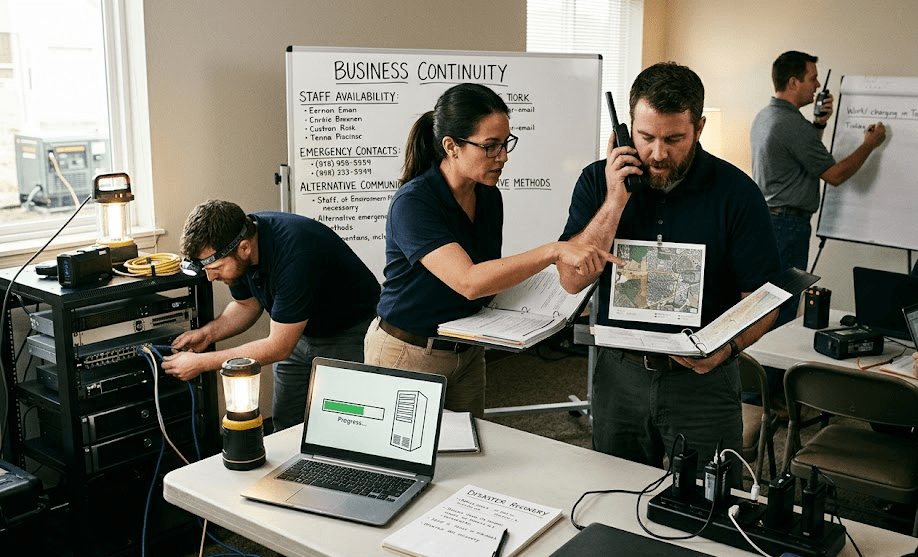
The two plans fit together when the recovery targets are set by the business impact analysis, not by IT preferences. This is where the abstract difference becomes concrete work. The Cybersecurity and Infrastructure Security Agency’s continuity resources describe the sequence well: assess impact first, then design recovery to meet the tolerances impact analysis reveals.
Start With a Business Impact Analysis
A business impact analysis ranks every business function by how long it can stop before the damage becomes severe. This is the foundation of the continuity plan, and it sets the requirements the recovery plan must hit. The analysis asks practical questions: if order processing stops, how many hours until we lose customers? If payroll cannot run, what is the legal and morale cost? The output is a ranked list of functions with tolerances, which tells you where to spend recovery money and where to accept slower restore times.
Set RTO and RPO From the Business, Not the Tools
Recovery time objective is how fast a system must come back, and recovery point objective is how much data you can afford to lose, both set by the business impact analysis rather than by what the backup software does by default. A common mistake is letting the tooling define these numbers. If your impact analysis says order processing must return within two hours, then a backup that takes six hours to restore fails the requirement no matter how reliable it is. Setting these targets from the business is what links the two plans. We cover the mechanics of these metrics in our wider disaster recovery service.
Plan the Human Side Alongside the Technical Side
Knowing What Is the Difference Between Business Continuity and Disaster Recovery emphasizes that human processes, communications, and manual workflows are as critical as technical recovery for full operational resilience. Name who declares an incident. Decide how staff and customers get notified when email is down. Document the manual process that keeps the most critical function running for a few hours without systems. This is the part recovery tooling never touches, and it is the part that most often fails companies in a real event. A tested call tree and a one-page manual workaround sheet do more on day one of an outage than another replication target.
Frequently Asked Questions
Is disaster recovery part of business continuity?
Yes, disaster recovery is a component of business continuity, focused specifically on restoring IT systems and data. Business continuity is the broader plan that covers people, communications, facilities, and operations alongside technology. You build recovery to meet the targets the continuity plan defines.
Can a company have disaster recovery without business continuity?
A company can have disaster recovery without business continuity, but it leaves the non-technical side of an outage unplanned. Systems may come back while the business still loses revenue because staff, customers, and manual processes were never addressed. The two work best as one connected program.
What is the main difference between an RTO and a continuity plan?
An RTO is a single recovery metric setting how fast a system must return, while a continuity plan is the full document covering how the whole company operates during disruption. The RTO lives inside the recovery plan, and the recovery plan serves the continuity plan. One is a number, the other is a strategy.
How often should both plans be tested?
Both plans should be tested at least annually and after any major change to systems, staff, or facilities. Recovery tests verify that restores actually work within their targets, while continuity tests verify that people know their roles. A plan that has never been exercised is an assumption, not a safeguard.
Talk to a Managed IT Strategist About Closing the Gap
Recognizing What Is the Difference Between Business Continuity and Disaster Recovery guides businesses in building strategies that not only restore systems but also ensure operations continue seamlessly during incidents. Most companies have built part of the picture, usually the technical part, and the missing half stays invisible until an outage exposes it. Our team builds both as one connected program, starting with a business impact analysis that tells us which functions cannot stop and for how long, then designing recovery to meet those exact tolerances and writing the human-side playbook that keeps customers served in the meantime. If you want to know whether your current plan covers the whole company or just the data center, book a free strategy call with a Mindcore strategist. We will map where your plan ends and where the real risk begins.
Disaster Recovery and Business Continuity Planning Expertise from Matt Rosenthal
Matt Rosenthal, CEO of Mindcore Technologies, has over 30 years of experience helping SMBs close the gap between having backup and failover tooling and having a plan that keeps the whole business operating when systems go down. He has seen firsthand how companies recover their servers in hours but still lose days of revenue because nobody documented who approves manual orders, where the offline customer list lives, or how to communicate with clients when email is unavailable. Matt leads a team that builds disaster recovery and business continuity as one connected program, with recovery time objectives set by business impact analysis rather than IT defaults, and the human-side playbook written and tested alongside the technical restore path.